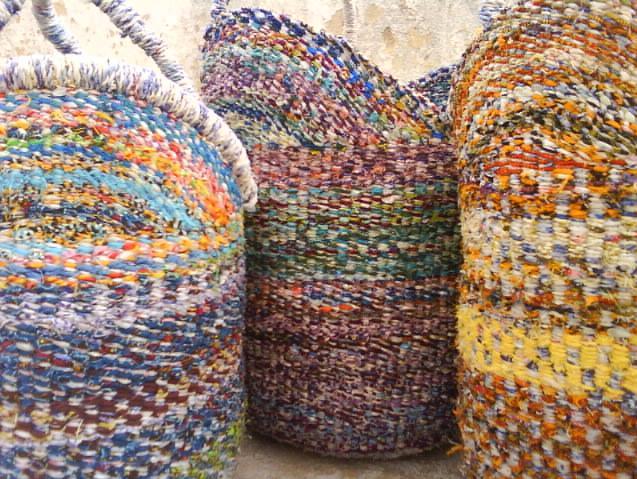
We’ll be holding recycled Basket giveaways over at G-lish too. If you want a chance to win one of these be-you-T-full baskets, wherever you are in the world, subscribe to G-lish! Winners will be announced at the end of the month.
Meanwhile, if you can’t wait that long, and you’re in Ghana, you can find the baskets at Trashy Bags in Accra. Check out Trashy Bags videos for more info on their brilliant work in the capital of Ghana.
We’ll also be holding competitions along those lines here so look out and be sure to enter this one if you want to win.
Showing posts with label Trashy Bags. Show all posts
August 31, 2010
August 30, 2010
Warning: Recycled Baskets Contain Love
WARNING: As a Recycled Bolga Basket I should mention that I’m created from 230 “pure water” plastic bags, and over 2 yards of scrap cloth. Yes—I was once waste, but I’m now rather striking don’t you think? It’s all thanks to the brilliant, basket-weaving communities of Bolgatanga in the Upper East Region of Ghana who will be able to buy medicine and pay school fees when you buy me. That’s because they get paid fairly for creating me. Oh, and for every basket you buy, G-lish plants a tree in Bolgatanga, regenerating the deforested, northern-most region of Ghana—and creating sources of food, shade and shelter in the community.
G-lish’s vision: Thousands of us baskets will find homes across the globe and thousands of trees blossom across the Upper East.
G-lish: solving environmental problems, preserving an age-old handicraft tradition, and providing sustainable incomes for impoverished, rural, Ghanaian craftswomen and men. (They’re not basket cases in Bolga, I can tell you!)
Look out for more at G-lish: www.g-lish.org. Contact: baskets@g-lish.org
The basket-makers asked me to tell you…
“We thank you! Teppohzoe!”
Find the baskets at Trashy Bags in Accra. Click the image at the top of the pagwe for directions.
G-lish’s vision: Thousands of us baskets will find homes across the globe and thousands of trees blossom across the Upper East.
G-lish: solving environmental problems, preserving an age-old handicraft tradition, and providing sustainable incomes for impoverished, rural, Ghanaian craftswomen and men. (They’re not basket cases in Bolga, I can tell you!)
Look out for more at G-lish: www.g-lish.org. Contact: baskets@g-lish.org
The basket-makers asked me to tell you…
“We thank you! Teppohzoe!”
Find the baskets at Trashy Bags in Accra. Click the image at the top of the pagwe for directions.
That's what's on the lable of the baskets!
August 29, 2010
One Basket = One Tree
Another positive aspect of the recycled Bolga basket project is that for every basket sold the producers plant a tree in the community. Currently they are planting mango trees, the most popularly requested, since mangos provide excellent shade during the extremely hot season and have a natural cooling effect. They are the coolest places to be when outdoors during the hot season.
Of course, they also provide fruit and nutrition which are much needed in the Upper East where the average diet consists of cornmeal porridge and soup—not at all meeting daily nutrition requirements.
For the record, the price of the Ghana guide will increase as we also have a campaign to plant one tree for every guide sold—increasing the tree-planting scope so that thousands of trees will begin to grow across deforested parts of Ghana where they are badly needed.
Trees are valued and precious in Bolga because of the need for shade and wish for fruit to supplement the very bland diet. The basket makers and producers are very excited about this.
This is a long term vision, inspired by Wangari Maathai’s Greenbelt movement.
So, when you buy a recycled Bolga basket, you’re not only providing livelihoods to Ghana’s poorest men, women and youth, but also providing shade, shelter and sources of food for many years to come and greening Ghana too.
A basket maker in the cool of dusk. You can see how barren the Upper East is. We need trees!
Of course, they also provide fruit and nutrition which are much needed in the Upper East where the average diet consists of cornmeal porridge and soup—not at all meeting daily nutrition requirements.
For the record, the price of the Ghana guide will increase as we also have a campaign to plant one tree for every guide sold—increasing the tree-planting scope so that thousands of trees will begin to grow across deforested parts of Ghana where they are badly needed.
Trees are valued and precious in Bolga because of the need for shade and wish for fruit to supplement the very bland diet. The basket makers and producers are very excited about this.
This is a long term vision, inspired by Wangari Maathai’s Greenbelt movement.
So, when you buy a recycled Bolga basket, you’re not only providing livelihoods to Ghana’s poorest men, women and youth, but also providing shade, shelter and sources of food for many years to come and greening Ghana too.
Labels:
Accra,
Africa,
blogsherpa,
Bolga Baskets,
Ghana,
recycled products,
Trashy Bags
July 25, 2010
Trashy in Name Only
I referred to an article written by Emily Bowers in the first of this series about the plastic problem in Ghana. I encourage you to read the entire article, Burkina Faso Women Spin Trash Into Exports. While the article refers to Burkina Faso, it could just as easily refer to Ghana. There’s not much difference in the circumstances she describes.
Here’s a little more of what she wrote, in case you don’t read the whole story.
Across Africa, women are becoming more involved in environmental initiatives, spurred on by role models such as Wangari Maathai's Green Belt Movement, which started in Kenya to encourage women to plant trees and expanded into other African countries.
In 2004, Maathai brought environmental activism in Africa to the forefront, winning the Nobel Prize for Peace and encouraging other women and girls to take the lead in environmental protection. She also created economic opportunity for women as she paid them to reforest Kenya.”
The women began crocheting plastic bags into dolls and they now export the dolls and other products to the USA from their cooperative in Burkina Faso, as well as selling to local tourists.
“Lamizana also showed off a washing board, formed from melted plastic and molded into a typical, if old-fashioned, board. At their booth in the Village Artisanal de Ouagadougou, their main clientele are browsing tourists, who will pay a few dollars for the smaller items and $20 or more for a large bag.”
The same type of activities have been happening here in Ghana for some years now. Trashy Bags in Accra are selling “recycled Bolga baskets” in their store in Accra made from woven, recycled plastic bags and cloth. These baskets use traditional basket making techniques but use recycled materials.
Each basket uses 170 pure water plastic bags on average, and about 1.7 yards of recycled cloth, that would otherwise be burnt along with the plastic.
You can visit their show room in Accra and buy recycled Bolga baskets and Trashy Bag’s products like shoulder bags and purses by catching a taxi to Dzorlu and visiting the showroom. Click our header image or the side bar links for directions to the Trashy Bags showroom in Accra.
Here’s a little more of what she wrote, in case you don’t read the whole story.
Across Africa, women are becoming more involved in environmental initiatives, spurred on by role models such as Wangari Maathai's Green Belt Movement, which started in Kenya to encourage women to plant trees and expanded into other African countries.
In 2004, Maathai brought environmental activism in Africa to the forefront, winning the Nobel Prize for Peace and encouraging other women and girls to take the lead in environmental protection. She also created economic opportunity for women as she paid them to reforest Kenya.”
The women began crocheting plastic bags into dolls and they now export the dolls and other products to the USA from their cooperative in Burkina Faso, as well as selling to local tourists.
“Lamizana also showed off a washing board, formed from melted plastic and molded into a typical, if old-fashioned, board. At their booth in the Village Artisanal de Ouagadougou, their main clientele are browsing tourists, who will pay a few dollars for the smaller items and $20 or more for a large bag.”
The same type of activities have been happening here in Ghana for some years now. Trashy Bags in Accra are selling “recycled Bolga baskets” in their store in Accra made from woven, recycled plastic bags and cloth. These baskets use traditional basket making techniques but use recycled materials.
Each basket uses 170 pure water plastic bags on average, and about 1.7 yards of recycled cloth, that would otherwise be burnt along with the plastic.
You can visit their show room in Accra and buy recycled Bolga baskets and Trashy Bag’s products like shoulder bags and purses by catching a taxi to Dzorlu and visiting the showroom. Click our header image or the side bar links for directions to the Trashy Bags showroom in Accra.
Labels:
Accra,
Africa,
blogsherpa,
bolga baskets,
Ghana,
recycled,
Trashy Bags
July 24, 2010
My Silent Goaty Bolga Basket
Did you have to sing that song in school? We did. It gets stuck in my head all the time now.
It went like this (I think—I’m notorious for mixing up song lyrics):
My silent goaty oaty oaty oaty oaty
Was doing fine ine ine ine ine
He ate three shirty irty irties
Off my back line ine ine ine ine
Or something like that.
Here in Ghana we could sing:
He ate three rubbers ubbers ubbers ubbers ubbers
From in the gutter utter utter utter utter utter
Or something like that.
Either way, they choke.
In her article about the problem in Burkina Faso, Emily Bowers wrote:
“Here, women were worried about the mysterious deaths of their goats. When they realized their animals were munching on the plastic bags and dying shortly after, they decided to do something to clean up the filth.”
Who wants to eat “Aponkye Nkrakra” (goat light soup) flavoured with plastic bags?
Maybe that’s why I don’t like the taste of goat: it’s the plastic.
If you would rather enjoy your plastic on the outside, then take a twenty minute trip to Trashy Bags in Accra where plastic is recycled into brilliant, handmade bags and purses. You can also find these brilliant Bolga baskets made from recycled pure water bags and cloth there.
It went like this (I think—I’m notorious for mixing up song lyrics):
My silent goaty oaty oaty oaty oaty
Was doing fine ine ine ine ine
He ate three shirty irty irties
Off my back line ine ine ine ine
Or something like that.
Here in Ghana we could sing:
He ate three rubbers ubbers ubbers ubbers ubbers
From in the gutter utter utter utter utter utter
Or something like that.
Either way, they choke.
In her article about the problem in Burkina Faso, Emily Bowers wrote:
“Here, women were worried about the mysterious deaths of their goats. When they realized their animals were munching on the plastic bags and dying shortly after, they decided to do something to clean up the filth.”
Who wants to eat “Aponkye Nkrakra” (goat light soup) flavoured with plastic bags?
Maybe that’s why I don’t like the taste of goat: it’s the plastic.
If you would rather enjoy your plastic on the outside, then take a twenty minute trip to Trashy Bags in Accra where plastic is recycled into brilliant, handmade bags and purses. You can also find these brilliant Bolga baskets made from recycled pure water bags and cloth there.
Labels:
Africa,
blogsherpa,
Bolga Baskets,
environment,
g-lish.org,
Ghana,
recycled products,
Trashy Bags
July 21, 2010
A Plastic Bag for Your Thoughts
This post continues on from the earlier one: Rubbish Rubbish Everywhere, Ghana’s on the Brink
A stroll along any road in virtually any city or village in Ghana invites ugly scenes: plastic rubbish virtually everywhere. It’s one of the major complaints tourists have about traveling in Ghana.
I feel like plastic bags have become a status symbol here in Ghana. I’ll explain. It’s like a “gift with purchase” almost. As in, you purchased a bottle of water, here’s your free plastic bag with that. People are proud to carry handfuls of black plastic bags as though it’s a sign of progress like some small middle-developing nations purchase tiny cars to clog up the already crowded streets and emit yet more CO2 into the choking atmosphere.
When we shop in the market, we take our huge Shop Rite heavy duty bag and pile fruits and vegetables on top of each other inside. Despite protestations and pointing into our bag to demonstrate that we don’t use “rubbers,” traders don’t listen.
“Here’s a plastic bag anyway,” they seem to say, peeling off a plastic bag and handing it to us after we place the fruit in our big bag with all the other items.
We have to forcefully refuse this offer everywhere we go. In the pharmacy we’re offered a plastic bag with our little tiny box of medicine. In the store we’re offered a plastic bag with a small tin of milk.
And Ghanaians complain about being poor. Imagine how much money would be saved if no one handed out black plastic bags for a month. There’s a cost none of us needs when we buy food. Imagine the savings. If we’re paying 5 pesewas a plastic bag, say, and we consume one or two a day, that’s a saving of 10 pesewas a day. Now, where I live, that’s a lot of money for some folks. Apply that across the country and there is a whole lot of money that can be spent on food instead of plastic.
I have never seen anyone refuse a plastic bag. I remember as a kid the same thing in Australia. No one thought twice about taking a plastic bag for a packet of bread that was already packaged in plastic. That mentality changed with time and education. The same will have to happen here if, and this is the big if, the country values its environment.
That’s the question, though. Does anyone in Ghana really value their environment?
As I wrote in the first post, ‘While the Ugandan Government banned plastic bags in 2007, in Ghana pure water sales provide considerable employment and it is argued “the economic implications of a ban would just be too significant.”’
That is part of the problem. Most people cannot get access to clean drinking water. You risk all sorts of diseases by drinking straight from the tap. The alternative is plastic bottles, which are too expensive for most people and possibly even worse for the environment. So, until we can get access to clean drinking water, “pure water” it will have to be. (How pure it actually is, is anyone’s guess.)
This would not be the huge problem it is if these bags were taken home and recycled, or put in rubbish bins and recycled. One of these options has to become reality. If not, the plastic that someone throws away today will still be in the ground or water when the babies born this year, in 2010, go to university in 2030.
Pure water plastic bags will be around for 20 years, they don’t ever truly break down. And 40,000 of them are discarded every day in Accra central, alone. You can imagine the impact to the soil, rivers and water catchments across all of Ghana. God knows what type of poisons being leeched from plastic rubbish enter the water ways.
Fortunately, there are some rubbish collection services in Ghana, like Zoomlion, but they alone cannot cope with the problem.
The solution lies with each person not littering. And in either recycling or phasing out the use of plastic bags altogether. That’s the long-term solution. The Ugandan example.
Meanwhile, a lot of small and large NGOs have begun turning this rubbish into creative products. You can find them at Trashy Bags in Accra, a popular haunt for travelers and expats. They’ve been doing this for years now, and have become very good at it. All those Fan Yogo and Fan Ice wrappers, as well as pure water and juice wrappers, are sewn into bags and purses that make great personal gifts when you’re returning home, or for you yourself during your stay in Ghana.
Here is a link to Trashy Bags web site where you can browse products and get directions to their Accra show room. The baskets in the header image on this blog are also available there--but be quick.
And here is a link to the excellent Fantastic Plastic video about their story.
Image by Terence
A stroll along any road in virtually any city or village in Ghana invites ugly scenes: plastic rubbish virtually everywhere. It’s one of the major complaints tourists have about traveling in Ghana.
I feel like plastic bags have become a status symbol here in Ghana. I’ll explain. It’s like a “gift with purchase” almost. As in, you purchased a bottle of water, here’s your free plastic bag with that. People are proud to carry handfuls of black plastic bags as though it’s a sign of progress like some small middle-developing nations purchase tiny cars to clog up the already crowded streets and emit yet more CO2 into the choking atmosphere.
When we shop in the market, we take our huge Shop Rite heavy duty bag and pile fruits and vegetables on top of each other inside. Despite protestations and pointing into our bag to demonstrate that we don’t use “rubbers,” traders don’t listen.
“Here’s a plastic bag anyway,” they seem to say, peeling off a plastic bag and handing it to us after we place the fruit in our big bag with all the other items.
We have to forcefully refuse this offer everywhere we go. In the pharmacy we’re offered a plastic bag with our little tiny box of medicine. In the store we’re offered a plastic bag with a small tin of milk.
And Ghanaians complain about being poor. Imagine how much money would be saved if no one handed out black plastic bags for a month. There’s a cost none of us needs when we buy food. Imagine the savings. If we’re paying 5 pesewas a plastic bag, say, and we consume one or two a day, that’s a saving of 10 pesewas a day. Now, where I live, that’s a lot of money for some folks. Apply that across the country and there is a whole lot of money that can be spent on food instead of plastic.
I have never seen anyone refuse a plastic bag. I remember as a kid the same thing in Australia. No one thought twice about taking a plastic bag for a packet of bread that was already packaged in plastic. That mentality changed with time and education. The same will have to happen here if, and this is the big if, the country values its environment.
That’s the question, though. Does anyone in Ghana really value their environment?
As I wrote in the first post, ‘While the Ugandan Government banned plastic bags in 2007, in Ghana pure water sales provide considerable employment and it is argued “the economic implications of a ban would just be too significant.”’
That is part of the problem. Most people cannot get access to clean drinking water. You risk all sorts of diseases by drinking straight from the tap. The alternative is plastic bottles, which are too expensive for most people and possibly even worse for the environment. So, until we can get access to clean drinking water, “pure water” it will have to be. (How pure it actually is, is anyone’s guess.)
This would not be the huge problem it is if these bags were taken home and recycled, or put in rubbish bins and recycled. One of these options has to become reality. If not, the plastic that someone throws away today will still be in the ground or water when the babies born this year, in 2010, go to university in 2030.
Pure water plastic bags will be around for 20 years, they don’t ever truly break down. And 40,000 of them are discarded every day in Accra central, alone. You can imagine the impact to the soil, rivers and water catchments across all of Ghana. God knows what type of poisons being leeched from plastic rubbish enter the water ways.
Fortunately, there are some rubbish collection services in Ghana, like Zoomlion, but they alone cannot cope with the problem.
The solution lies with each person not littering. And in either recycling or phasing out the use of plastic bags altogether. That’s the long-term solution. The Ugandan example.
Meanwhile, a lot of small and large NGOs have begun turning this rubbish into creative products. You can find them at Trashy Bags in Accra, a popular haunt for travelers and expats. They’ve been doing this for years now, and have become very good at it. All those Fan Yogo and Fan Ice wrappers, as well as pure water and juice wrappers, are sewn into bags and purses that make great personal gifts when you’re returning home, or for you yourself during your stay in Ghana.
Here is a link to Trashy Bags web site where you can browse products and get directions to their Accra show room. The baskets in the header image on this blog are also available there--but be quick.
And here is a link to the excellent Fantastic Plastic video about their story.
Image by Terence
Labels:
Africa,
blogsherpa,
environment,
G-lish,
Ghana,
recycled products,
Trashy Bags
July 18, 2010
The Rubbish Monster
I read an excellent article a while back. It’s about the plastic bag problem in Africa.
Plastic bags are to the Ghana landscape what fallen leaves are to Autumn landscapes in cooler parts of the world. Unfortunately, this is not a seasonal phenomenon; it’s a 365 day a year phenomenon.
Plastic bags are simply everywhere, fluttering from high tension wires, scattered across fields and between rows of maize. They are piled high in drains and burning in piles by roadsides everywhere, emitting noxious gases in close urban quarters.
In fact, it was the “burning rubbish” smell that I was yearning for when I returned to Ghana in 2007. That’s what I couldn’t wait to smell when I alighted from the belly of the airplane in Accra. That’s the smell of Ghana.
The writer, Emily Bowers, wrote:
Traveling across West Africa, it's easy to tell when you're coming to a town or city: the spindly brown trees become decorated with plastic bags like Christmas tree tinsel. Caught in shrubs and on fences, the bags clog sewers and water sources. They are ubiquitous; simple plastic bags are handed out with practically every purchase at a market stall or container shop.
I have been told that plastic bags only became common in Ghana around 1995 or 1996. It’s not as if there is a long history with the bag. There is a long history with the cloth, the bowl or the basket however, traditional means of carrying goods in Ghana.
But the plastic bag thing caught on like the flu. And it seems like it’s going to be just as difficult to shake. Here, the bag is called a “rubber” and it’s almost always black. And then there’s the pure water bags. Everywhere.
Statistics released by the Accra Metropolitan Assembly (AMA) and other waste management bodies indicate some 270 tonnes of plastic waste is generated each day in Accra alone. “Pure water” sachets represent 85% of this waste. 40,000 sachets are discarded daily in Accra and take 20 years to degrade partially; they will never fully disintegrate. While the Ugandan Government banned plastic bags in 2007, in Ghana pure water sales provide considerable employment and it is argued “the economic implications of a ban would just be too significant.”
TO BE CONTINUED.
Meanwhile, check out one business doing a brilliant job at combating this problem: Trashy Bags in Accra. You can visit their showroom and buy brilliant products made exclusively from recycled plastic rubbish. The directions are on their web site.
Trashy Bag image by Trashy Bags.I read an excellent article a while back. It’s about the plastic bag problem in Africa.
Plastic bags are to the Ghana landscape what fallen leaves are to Autumn landscapes in cooler parts of the world. Unfortunately, this is not a seasonal phenomenon; it’s a 365 day a year phenomenon.
Plastic bags are simply everywhere, fluttering from high tension wires, scattered across fields and between rows of maize. They are piled high in drains and burning in piles by roadsides everywhere, emitting noxious gases in close urban quarters.
In fact, it was the “burning rubbish” smell that I was yearning for when I returned to Ghana in 2007. That’s what I couldn’t wait to smell when I alighted from the belly of the airplane in Accra. That’s the smell of Ghana.
The writer, Emily Bowers, wrote:
Traveling across West Africa, it's easy to tell when you're coming to a town or city: the spindly brown trees become decorated with plastic bags like Christmas tree tinsel. Caught in shrubs and on fences, the bags clog sewers and water sources. They are ubiquitous; simple plastic bags are handed out with practically every purchase at a market stall or container shop.
I have been told that plastic bags only became common in Ghana around 1995 or 1996. It’s not as if there is a long history with the bag. There is a long history with the cloth, the bowl or the basket however, traditional means of carrying goods in Ghana.
But the plastic bag thing caught on like the flu. And it seems like it’s going to be just as difficult to shake. Here, the bag is called a “rubber” and it’s almost always black. And then there’s the pure water bags. Everywhere.
Statistics released by the Accra Metropolitan Assembly (AMA) and other waste management bodies indicate some 270 tonnes of plastic waste is generated each day in Accra alone. “Pure water” sachets represent 85% of this waste. 40,000 sachets are discarded daily in Accra and take 20 years to degrade partially; they will never fully disintegrate. While the Ugandan Government banned plastic bags in 2007, in Ghana pure water sales provide considerable employment and it is argued “the economic implications of a ban would just be too significant.”
TO BE CONTINUED.
Meanwhile, check out one business doing a brilliant job at combating this problem: Trashy Bags in Accra. You can visit their showroom and buy brilliant products made exclusively from recycled plastic rubbish. The directions are on their web site.
Trashy Bag image by Trashy Bags.I read an excellent article a while back. It’s about the plastic bag problem in Africa.
Labels:
Accra,
Africa,
blogsherpa,
environment,
Ghana,
recycled products,
Trashy Bags
Subscribe to:
Posts (Atom)