Showing posts with label fair trade. Show all posts

November 15, 2014

We have just released the Fair Market report on prices paid in the straw Bolgatanga basket industry in #Ghana. Click the secure link to the Fair Market Report on Bolga Baskets and it will open up in PDF directly.

We look forward to working together to bring about change in this industry so that the thousands of people involved in making baskets will earn at least the minimum wage in #Ghana from weaving #baskets and other products sold through the central market.

Our research found that NONE of the 120 weavers we interviewed ever received anywhere near a price that met the minimum wage in Ghana when they sold a large market basket in the central market to traders.

The images in this post show scenes from a typical market day in Bolgatanga central market. Here, a woman is attempting to sell 5 baskets. A trader is amassing baskets purchased off the street and around the market. 

The problem

Over several years living in Bolgatanga, basket weavers often commented to us, the authors of this report, that a weaver could not profit from making baskets. We wondered why this was so. What was impeding their profit-making ability?

In our own work in villages we observed that many weavers were illiterate and not in a position to negotiate prices or selling conditions with traders. We wondered what weavers themselves, across the region, would tell us if we gave them a chance to express themselves about these issues.
We wondered what buyers would do if they knew the conditions around the central market in Bolgatanga.

Would buyers be motivated to find a way to ensure the weaver received a fair price?
We wondered if having a clear picture might bring about change for everyone in the supply chain.

Outcome (see p. 89, Conclusion).

After completing this research it is difficult to conclude that selling straw baskets in the central Bolgatanga straw basket market serves straw basket weavers’ interests in any form whatsoever.
If any interests are served, they are those of the middlemen traders, exporters and others in the supply chain who profit.

One thing that is clear from this research is that it is not the straw basket weavers who profit from their work.

Far from helping weavers profit, the prices paid for straw baskets sold in the central Bolgatanga basket market do not cover the cost of a weaver’s time and, thus, do not meet the minimum wage in Ghana.

The middlemen traders, the exporters, the shipping companies, and international buyers profit on the back of the humble basket weaver’s time and skill.

However everyone, including the weavers themselves, could benefit if the straw basket weavers were remunerated for their costs and time.

Whilst this research benchmarked one basket—the round market basket – those who work with baskets and observe prices paid for other styles of baskets in the central market will know that no baskets are fairly remunerated.

Thanks and Gratitude

G-lish Foundation is grateful to the Australian High Commission in Ghana and the Australian Government’s Direct Aid Program for the grant that enabled this work to be undertaken between 2012 and 2013 in the Upper East Region of Ghana. We thank everyone at the Australian High Commission for their faith and support which enabled us to carry out unprecedented work which has the potential to transform many lives in Ghana’s second poorest region.

This work is about a simple basket. The injustice we observed that became this project and now this report is about the people who make it, the end consumer, the people who trade them, and all the people in between.

Ultimately, it’s about choices: how you choose to spend your money. We hope that this work can be broadened to other crafts and communities so that buyers may take action wherever they make a choice about prices paid to artisans.

We would like to thank the 120 weavers from six weaving villages we visited: Dulugu, Tongo-Beu, Gambigigo, Sirigu, Sumburungu and Nyariga. They shared their experiences in great detail. We have over 2400 minutes of recorded interviews in Frafra (translated into English) with the 120 weavers across these six communities. The interviews form part of this report.

We would also like to thank the community leaders of these six communities who allowed us to undertake this work in their communities.

We would like to thank the international buyers who participated in the online survey and provided valuable written information about their experiences buying baskets via the survey and in emails. We would like to thank the few basket producing businesses in Bolgatanga who opened up about their processes, prices and experiences working with weavers and international buyers, and agreed to show us all documentation and systems information.


We would like to thank our colleagues in G-lish Foundation, past and present, whose courage and hard work were crucial in making this happen.  We intend to continue to undertake advocacy for the weavers of Bolgatanga to ensure they receive fair remuneration for their work. Thank you for taking the time to read this. Contact details are at the end of this report if you wish to stay involved in helping bring about economically empowering change for basket weavers in Ghana.

Hashtag: #BasketGood to comment on this in social media.
Twitter: @gaylepescud @godwinyidana1 @G_lishGhana.
Facebook: http://www.facebook.com/GlishFoundationGhana

Message us here with any questions or comment below. In the next two days we will be inviting buyers to a private, locked, online forum in which we'll discuss the issues here in more detail and share experiences in order to better understand and find solutions to the issues.


August 26, 2010

Recycled Bolga Basket Stars

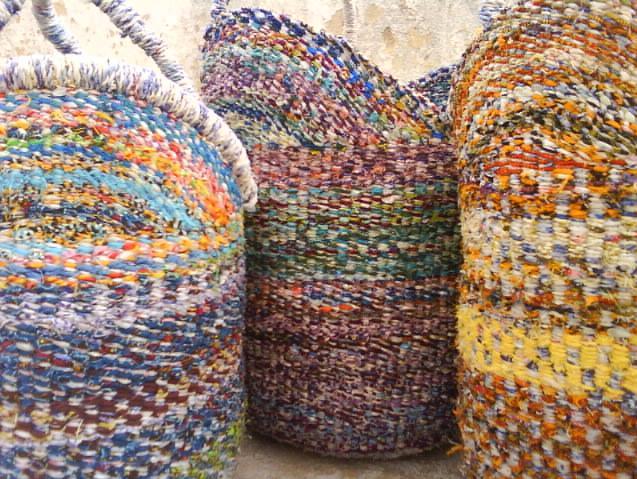
A glimpse of some of the basket makers working on recycled Bolga baskets. The producers work from their home, usually a mud and thatch room in a large family compound. They work on the baskets as time and commitments allow.


Right now it’s harvest time so everyone is busy on their maize and millet farms. Many have children that they attend to while working on the baskets too.


You can find these truly unique, world-first (we believe…correct us if this is done anywhere else), gorgeous baskets at Trashy Bags in Accra.

May 6, 2010

Ethical and Fair Trade Shops UK and USA

Mother's Day is coming up next week in the USA. And it's World Fair Trade Day next weekend too. We've recently been accepted to promote fair trade products and, to disclose fully, we will be rewarded for this as an affiliate. I love fair trade, I've worked in the area and I've written a lot about it so it makes sense to me. I love to promote products that I know will help alleviate poverty at the grass-roots. 


If you live in the USA, you may wish to mosey on down to your local Fair Trade Shop and buy Mum a box of Fair Trade organic chocolate. Online, of course. 


As someone who lives in the world's second largest cocoa producing country where stories about unfair practices in the industry abound, I can tell you that putting pressure on producers by demanding fair trade practices makes a difference. It's a steady and sure way to make change, to make poverty history, and to ensure a more equitable existence for many. And your Mum will love you for it. Click the picture and see for yourself.

globalexchangestore.com-banner576x600

If you live in the UK, you can high tail it to the online Ethical Super Store (oh my God this is amazing) which sells everything a modern household needs, and lovely gifts to boot.  Better still, they sell Traidcraft products and as someone who once worked for Traidcraft I know they do what it says on the box. When you buy from Ethical Superstore you get a choice of marvelous products from all over the world--dishwashing liquid, mops, solar lighting, garden accessories, furniture, fantastic skincare products, books, music, DVDs, wine, I mean EVERYTHING. Click the picture or the link and see for yourself. 


March 18, 2010

Are you MaD: All about fair trade!

This week's Are you MaD post focuses on fair trade. There is so much happening in that field, Are you MaD: Fair Trade. Click and check out the full post at www.g-lish.org. You'll see reviews of four excellent organisations and experience a relity check about the chocolate you're tasting too. You can read about one Ghanaian's terrible trip to the Ivory Coast in Facing up to an Ivorian gun runner to get a sense of how children and youth end up slaving on cocoa farms today.

This image which shows fair trade coffee is courtesy of william.neuheisel at Flickr.

This image on the left is of a Chinese/Mandarin language poster advocating fair trade by Oxfam. That's certainly one of the markets to target as far as lobbying for better working and trading conditions is concerned.

To read what four excellent orgnisations are doing, go to Are you MaD: Fair Trade.

Download a free sample of our Travel Guide to Ghana see inside the guide before buying.

November 12, 2009

Top 10 fair trade holidays

We have a new site www.g-lish.org where you can read all articles from This is Ghana in a much more organised fashion. Read Top 10 fair trade holidays there.

This article was published by The Guardian, UK, in February 2008. If you're looking for a fair trade holiday, or want to know a little more about taking a break that helps sustain the communities through which you travel, you might want to check it out.

Here's an excerpt:
In other developing countries, there are lots of holidays that qualify, informally, as fair trade, but to find them you have to do the homework. One option is to stay in locally owned accommodation, such as homestays and community-run lodges, where the money you spend goes into the hands of local people. Another is to visit some of the Fairtrade coffee farms and tea plantations whose workers are opening up their homes to tourism to supplement their meagre income. Most are small-scale farmers who are passionate about their countryside and culture, and welcome you into their life.
In Ghana, one of the places that would come closest to qualifying as a fair trade destination would be Green Turtle Lodge. Check them out here.

Lodges at Green Turtle. Photo courtesy of Green Turtle Lodge.

September 9, 2009

A bare-faced promo: Fair Trade Event in London this Sat


We have a new site www.g-lish.org where you can read all articles from This is Ghana in a much more organised fashion. Read A bare-faced promo: Fair Trade Event in London this Sat there.

If you're in Leytonstone, London, pop along to a fun day of African-inspired activities this Saturday. This is a fund raiser organised by my very good friend Liz to raise money to build a school in Butre, Ghana. They've been working on the project for the past couple of years, with plenty of past fundraisers, and you can help give them a boost. There's even Bollywood dancing, and why not? I don't know what the chocolate fountain is, but if I were you, I'd go check it out. And, of course, the drumming!

Butre is the destination of a popular backpacker lodge, Ellis Hideout, but also happens to have a serious elephantiasis problem which affects long-term residents. When I visited I met a man whose entire leg was swollen from the disease. Their school will include a clinic to address that problem in particular, as well as provide a much-needed boost to the existing educational facilities. And if you see my friend Liz (she has the wild curly hair), say hi!

April 15, 2009

Fair trade series: Why bother?

We have a new site www.g-lish.org where you can read all articles from This is Ghana in a much more organised fashion. Read Fair trade series: Why bother? there.


If no one had clued on to the idea of fair trade sixty years ago, we wouldn’t have over 1 million small producers around the world engaged in fair trade today. According to WFTO there are more than 3000 organisations spanning more than 50 countries.

One billion people around the world live in “extreme poverty”. Another 2.5 billion live in “poverty”. Our affluent western lifestyle is the global exception, not the norm.

The reason to bother is because by buying fair trade you can be assured that you’re assisting someone out of poverty and towards a future where they have options.

It’s hard to describe the difference one more dollar makes to someone who earns a dollar a day in a few words. It’s the difference between getting medical treatment and not. It’s the difference between subsistence and saving. It’s the difference between being able to send your kids to school and not, even if they can’t afford shoes. As my Ghanaian fiancĂ© said of his impoverished childhood: “my head was learning, not my feet; I could still attend school without shoes”.

Campaigns like World Vision’s dollar a day to help needy children are clichĂ©s these days, but they’re not kidding; it really does make a difference.

But, imagine if those communities had the opportunity to earn the money legitimately, themselves, instead of relying on foreign aid organizations for "handouts".

I think these are persuasive arguments for bothering with fair trade.

April 8, 2009

Ethical Fashion (Part III)

We have a new site www.g-lish.org where you can read all articles from This is Ghana in a much more organised fashion. Read Ethical Fashion (Part III) there.


Ethical Fashion article published in www.newconsumer.org (following Part II of the article: http://gisforghana.blogspot.com/2009/04/ethical-fashion-part-ii.html)

Marks & Spencer is adding organic cotton to its garments. And in a key development, clothes made of Fairtrade certified cotton from West Africa – Mali, Burkina Faso, Senegal and Cameroon – and Pakistan are now in shops in France, Belgium and Switzerland. Certified cotton is already a hit: within one month, Mali’s Fairtrade suppliers sold out, said Harriet Lamb. Certifiers are also currently working with farmers in India and Peru. In the UK, clothes made from Fairtrade Mark cotton will appear in shops within a year.

Ethical fashion has clearly been tough going for both Hewson and Hamnett. Finding enough organic cotton has been impossible. EDUN had to compromise, for example, by only using about one-third in its garments, though that proportion should jump to about 60 per cent in spring 2006. “We’ve also had to recognise the capabilities of the factories and use more local products,” she says. “But it’s two-way.” Apart from the obvious social benefit, she says they are using materials uncommon in haut couture – such as alpaca because one of their factories is in Peru. “It’s give and take,” she says.

For Hamnett, getting enough organic cotton has also been a nightmare. But, she says proudly, she is now the proud owner of 140,000 metres of organic tape for zippers. “Has that been done before? God, no.” She has been frustrated to find that the Fairtrade Foundation, in working to get certified clothes, favours small producers who cannot handle the volume she needs. “It’s really well-intentioned, but we do need people with capacity. They’re shooting themselves in the foot,” she says.

The foundation’s Harriet Lamb insists that they must exclusively work with small producers, as they did with Fairtrade coffee and tea. The smallest are most vulnerable, she says. The Foundation also targets small producers – coops, weavers, and sewers – who have already worked with established fair trade companies in the UK such as Bishopston Trading Co, because they have experience with fair trade procedures. But eventually, she says, the Foundation will start the process of certifying larger “hired labour” producers.

Despite the challenges, Hamnett is infectiously enthusiastic about consumers’ ability to change the world, from the grassroots, when governments are too timid. She says that ethical clothing is now her sole livelihood.

“I’m not going to be doing anything else. It’s reassuring in a darkening world. You feel as if there’s a chink.” That’s quite something from the woman who made headlines in 1984 when she shocked Margaret Thatcher with a political fashion statement. When the prime minister shook hands with Hamnett, at an official reception, the designer suddenly opened her jacket to reveal a t-shirt emblazoned with the anti-missile slogan: “58% Don’t Want Pershing.”

Ethical Fashion (Part II)

We have a new site www.g-lish.org where you can read all articles from This is Ghana in a much more organised fashion. Read Ethical Fashion (Part II) there.


Part II of Ethical Fashion article published at wwww.newconsumer.org (following from Part I: http://gisforghana.blogspot.com/2009/03/fair-trade-series.html)

"There is some concern, however, that headline-grabbing high fashion – style-led but which happens to be ethical – will cloud the complexities of the global issues. “There is a danger that publicity for the glamorous, fleeting designer fashion labels does not give consumers a fully balanced understanding of the issues,” said Tamsin Lejeune of the Ethical Fashion Forum. “Dedication and knowledge is not enough,” cautions Abigail Garner, co-founder of Gossypium. She says that real change only occurs if an ‘alternative fashion company’ cares deeply about three things: the final product, those who made it, and the raw materials used. “As soon as [fair trade] is fashion, it’ll disappear,” said one insider who preferred anonymity. “It’ll be replaced by the next fashion and god knows what that will do.”

Clothing is a risky business; it might be worse to raise expectations. Another said cautiously: “I hope they can sustain what they’re doing so it’s not a fad.” Fashion is notoriously fickle and cut-throat; and even for classic clothing the supply – including growers, dyers, weavers, designers and sewers – is far more complex than for tea or coffee. Fair trade fashion also has an extremely long lead time, because of the size of producers and the process. People Tree, signs three or five year contracts, says the company’s Helen Osgerby, which is highly unusual in the clothing industry.

The company is thus predicting fashion trends well in advance. “We don’t have the luxury that French Connection or the other high street shops have [of a fast turn-around], as we’re hand-making the whole collection,” she says. “We aim to be fashionable, but we don’t aim to be just trend-led and disposable. There is a human cost to speed.” Fair trade goes further than ethical trade – which focuses on decent working conditions and environmental standards – fair trade builds sustainable and long-term relationships with producers, builds on traditional skills and by definition invests in communities.

Fashion is overdue to be ripped apart at the seams. “If clothes had to list their real ingredients, bad labour standards and toxic chemicals they would need their own symbols”, say the organisers of RE:Fashion. Clothes are becoming ever cheaper and more disposable; factories move from country to country for the cheapest labour and loosest regulations; and more textiles are made of pesticide-drenched or genetically modified cotton or increasingly sophisticated man-made fibres. In the UK, we spend £30 billion yearly on clothes, or about £500 a person. Yet most of the millions who produce our increasingly cheap clothes live in dire poverty, according to Tearfund’s Lift the Label campaign.

Some 40 million people work in clothing and textiles worldwide, or about 14 per cent of jobs; and many are young women in developing countries who work in sub-standard conditions.

Wages in China may be as low as 17 pence an hour, according to the National Labour Committee. Indeed China, notorious for appalling human rights, is increasingly dominating the industry.

Guaranteed quotas – under the so-called Multi-Fibre Agreement – for less-powerful countries such as Bangladesh expired at the start of 2005.

Mass-produced cotton is especially egregious, although the main alternative is polyester, made from oil and which is now in more than 80 per cent of clothing.

Global cotton prices are half of what they were in 1960, in part because of the huge subsidies given to US cotton producers. In fact, America’s cotton subsidies were worth almost £2 billion in 2002, says Oxfam, nearly twice the US’s foreign aid to Sub-Saharan Africa.

Yet an estimated 100 million rural households depend upon cotton worldwide. The World Health Organisation estimates that 20,000 people die from pesticide poisoning yearly; and cotton is the most heavily sprayed crop. “What’s happening in cotton is completely scandalous,” says Harriet Lamb of the Fairtrade Foundation.

The shift towards ethical fashion is long-term, trend analysist Roger Tredre told the Financial Times. Spending on ethical fashion rose by 17 per cent to £273 million in 2003, according to the Co-op Bank. In another sign of the times, the second Ethical Fashion Show will be held in Paris in October during fashion week.

As many as 40 designers are expected, compared with 25 last year from Bangladesh, Ivory Coast, Senegal, Madagascar, South Africa, Philippines, Brazil, the UK and France. And early in 2005, the RE:Fashion event in London, featuring fair trade, organic and recycled clothing, was not only hosted by hip broadcaster Miranda Sawyer. It sold out."

March 29, 2009

Fair Trade Banana Wars

We have a new site www.g-lish.org where you can read all articles from This is Ghana in a much more organised fashion. Read Fair Trade Banana Wars there.


Since we're on the subject of fair trade, you may well ask: how the heck can buying a banana change the world?


It's worth finding out in "Fighting the Banana Wars and Other Fair Trade Battles" by Harriet Lamb.

As one reviewer on Amazon UK wrote:
I was inspired by the way that the book illustrates how Fairtrade provides stability to the farmers, and also gives them new power and hope. They decide whether to use the Fairtrade premium to build a school or wells or to provide healthcare. It gives them back their pride and voice - as one banana worker puts it - 'the banana worker is the poorest person in our society, managed and exploited by multinational corporations... I was someone that took a box and loaded it onto a train...In this new system I have become an international businessman'.
We'll be exploring these issues in more detail over the coming weeks.

Part 2 of our fair trade fashion article coming very soon!

March 25, 2009

Fair Trade Series + Ethical Fashion (Part I)

We have a new site www.g-lish.org where you can read all articles from This is Ghana in a much more organised fashion. Read Fair Trade Series + Ethical Fashion (Part I) there.


I'm starting a series of articles on the topic of fair trade that will run over the next few weeks.

Some of the issues that will be discussed include:
what is fair trade, anyway?
why bother?
issues in fair trade
purchasing power
lobbying power
resources - sites and books
labeling confusion
fair trade tourism
fair trade cotton
fair trade craft
fair trade food
Ghana and fair trade
-to name a few

To kick it off, I dug up an article on fair trade fashion that was published in New Consumer, a fantastic site on all things relating to ethical purchasing, a few years ago (around 2005/06, I believe).

Part one of the article: ETHICAL FASHION OR FASHIONABLE ETHICS?

As big name designers join the cause to make fashion fairer, Ros Davidson questions whether it’s just a trend.

‘Big name’ catwalk crusaders are giving a new meaning to the old adage, you are what you wear. This spring Ali Hewson launched her stylish and ethical EDUN collection. The art nouveau-inspired but edgy fashions, created in small factories in impoverished countries such as Lesotho, are now flying off the racks in shops in Britain, Ireland, Spain and the United States from Selfridges to Saks.

Some of the profits are reinvested in local communities in the developing world, for example for fixing a well at a school or providing day care, and the collection will eventually use Fairtrade certified cotton, says Hewson.

British designer Katharine Hamnett, hardly new to progressive causes, will unveil her ethical men’s in February 2006. Her women’s collection, also under the Katharine E Hamnett label – the ‘E’ stands for ethical and environmental – will follow soon after. The t-shirts, sweatshirts, knitwear and tailored suits will be “as environmental and ethical as we can get it,” she says. The textiles are as organic as possible, and 15 per cent of net profits will be re-invested in local communities.

Ali Hewson, when reached at her home near Dublin, says: “I don’t want to make clothes that are made from someone else’s despair.” The time is right, she says, with increasing awareness of worldwide poverty and that communities in the developing world prefer trade to aid: “Shopping is becoming politics.” Hewson’s husband, rocker and activist Bono, said at the New York launch: “This is the equivalent of mothers looking at the back of a can to see exactly what she is going to feed the kids.”

Katharine Hamnett, at her busy Islington base, talks rapid-fire and scathingly about exploitation in the fashion industry: “Most people in the fashion industry do not give a f***” – and about how she will never again work in conventional fashion. “It’s been incredibly hard and uphill but it’s better than aid. It’s on the ground.”

Out of disgust with mainstream fashion, she had severed as many contracts with conventional suppliers as possible in 2004. And finally, after years of unexpectedly hard slog, she will show her ethical men’s collection, for the first time, in late July at the Berlin Premium. Much of the foundation for ethical clothing was built, painstakingly over decades, by smaller companies. People Tree, Bishopston Trading Co, Gossypium and Chandni Chowk, among others, pride themselves on sustainable, transparent relationships with artisans and collectives in the developing world.

“In terms of raising the profile of ethical issues in fashion, these collections will be invaluable,” said Safia Minney, founder of People Tree, based in Tokyo and London and which has branched out into Selfridges and Italy and counts actress Sienna Miller as a customer.

Fiona Thomson of Traidcraft, one of Britain’s oldest fair trading companies, agrees: “This will increase stability and output for cotton growers in India. We cannot buy everything they supply.”

Rosalind Price of Chandni Chowk, which designs and produces garments and soft furnishings of hand-made, natural Indian textiles, also welcomes their arrival: “There are certain people who only buy fashion labels, and they’ll probably never come to us anyway. It’s exposure to a different market.” Or as Hewson says, “The more the merrier. We can be in this business and not damage others. The fashions are quite different, and the customer is very discerning.” Indeed the newcomers say there’s a gap in the market for ethical clothes that are less – to use the memorable words of the outspoken Hamnett – worthy, hirsute and eco.

Hewson and Hamnett can boost standards throughout the industry, because of their size, says Judith Condor-Vidal, economist and fair trade activist and who markets traditionally dyed Bangladeshi silk in the UK. “We welcome them!” More specifically, EDUN and Katharine Hamnett could help establish the Ethical Trading Initiative more widely in the fashion industry, says Helen Osgerby, spokesperson for People Tree. The initiative is a code of conduct for working conditions; members range from Monsoon, Levi Strauss and Marks and Spencer to Oxfam, CAFOD and the Fairtrade Foundation.

Read Part II of the article at: http://gisforghana.blogspot.com/2009/04/ethical-fashion-part-ii.html

January 9, 2009

Lifecycle of a handbag


We have a new site www.g-lish.org where you can read all articles from This is Ghana in a much more organised fashion. Read Lifecycle of a handbag there.


I was wandering up the road to work in regional Ghana minding my own business when I shouted “STOP!”

I knew that stylish, red, raw silk shoulder bag hanging alongside a motley range of developed-world seconds. And those daisies! I pulled my partner over the stinky gutter and into the tiny shack shop while I plucked the shiny red bag from its latch. My jaw almost fell into the sewer when I read: “Sentosa Silk, Cambodia.”

I knew it. Unmistakable. I worked with Sentosa in Phnom Penh. I sent their signature daisy purses home as gifts. What on earth was it doing here in Ghana? I knew the bag was made at a fair trade NGO, just like the one I worked for a few hundred metres up the road from where I was standing.

I hate shopping, and I’m no bargain hunter, but I had to know the price, especially because I knew the value--raw, hand-woven silk. And I’m constantly marveling at the developing world pecking order: ambulances donated to Ghana from Iran, for instance, and Cuban doctors doing the salsa down the corridors most hospitals here... Anyway.

So I ducked inside.
“How much?” I asked the owner. She sized me up.
“Five Ghana Cedis.” (That’s just under 5 US dollars.)
I almost fell over.
“It’s worth at least 20!” I whispered to my boyfriend outside in the sweltering sun.

I wanted to offer 10. Crazy. But I knew the effort that went into that bag.

So I left it. I figured some lucky Ghanaian could be the belle of the funeral (it was red and black: funeral colours) and nab a bargain they may never realize the true value of, and that it was hand made by young men and women working hard to overcome disabilities inflicted by land mines and other consequences of the civil war in another small developing nation half-way around the world.

We stepped over the open sewers and up the hill towards the Global Mamas office where hard-working Ghanaian women brought in their own fair trade creations.

Another "what on earth" moment in Ghana.

And what is it with the Cuban doctors anyway?

November 17, 2008

Global Mamas in Wall Street Journal

We have a new site www.g-lish.org where you can read all articles from This is Ghana in a much more organised fashion. Read Global Mamas in Wall Street Journal there.


In a defense of capitalism and caterpillar factories, the President made mention of his visit to Ghana earlier this year when he met two of our Global Mamas - Aggie and Esther - saw their work in action, and received a special briefing about Global Mamas work with reference to the impact of AGOA: the African Growth and Opportunity Act.
"I've walked the grounds of a trade fair in Ghana, where I met women who support their families by exporting handmade dresses and jewelry...."
AGOA allows us to export certain categories of products that are made in Ghana, such as our wearable fashion items, duty free into the USA. This provides a competitive pricing advantage in the US market, thereby supporting our growth in the USA market.

See full article at: http://online.wsj.com/article/SB122670648178429695.html
Visit Global Mamas at: http://www.globalmamas.org/

November 10, 2008

Global Mamas on Oprah


We have a new site www.g-lish.org where you can read all articles from This is Ghana in a much more organised fashion. Read Global Mamas on Oprah there.


Global Mamas panel skirt, gypsy skirt and easy wrap skirt make an appearance on Oprah.
Related Posts Plugin for WordPress, Blogger...