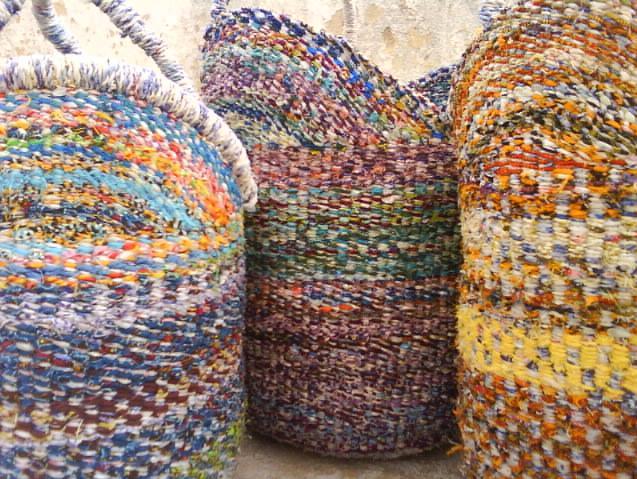
We have just released the Fair Market report on prices paid in the straw Bolgatanga basket industry in #Ghana. Click the secure link to the Fair Market Report on Bolga Baskets and it will open up in PDF directly.
We look forward to working together to bring about change in this industry so that the thousands of people involved in making baskets will earn at least the minimum wage in #Ghana from weaving #baskets and other products sold through the central market.
Our research found that NONE of the 120 weavers we interviewed ever received anywhere near a price that met the minimum wage in Ghana when they sold a large market basket in the central market to traders.
The images in this post show scenes from a typical market day in Bolgatanga central market. Here, a woman is attempting to sell 5 baskets. A trader is amassing baskets purchased off the street and around the market.

In our own work in villages we observed that many weavers were illiterate and not in a position to negotiate prices or selling conditions with traders. We wondered what weavers themselves, across the region, would tell us if we gave them a chance to express themselves about these issues.
We wondered what buyers would do if they knew the conditions around the central market in Bolgatanga.
Would buyers be motivated to find a way to ensure the weaver received a fair price?
We wondered if having a clear picture might bring about change for everyone in the supply chain.
If any interests are served, they are those of the middlemen traders, exporters and others in the supply chain who profit.
One thing that is clear from this research is that it is not the straw basket weavers who profit from their work.
Far from helping weavers profit, the prices paid for straw baskets sold in the central Bolgatanga basket market do not cover the cost of a weaver’s time and, thus, do not meet the minimum wage in Ghana.
The middlemen traders, the exporters, the shipping companies, and international buyers profit on the back of the humble basket weaver’s time and skill.
However everyone, including the weavers themselves, could benefit if the straw basket weavers were remunerated for their costs and time.
Whilst this research benchmarked one basket—the round market basket – those who work with baskets and observe prices paid for other styles of baskets in the central market will know that no baskets are fairly remunerated.
This work is about a simple basket. The injustice we observed that became this project and now this report is about the people who make it, the end consumer, the people who trade them, and all the people in between.
Ultimately, it’s about choices: how you choose to spend your money. We hope that this work can be broadened to other crafts and communities so that buyers may take action wherever they make a choice about prices paid to artisans.
We would like to thank the 120 weavers from six weaving villages we visited: Dulugu, Tongo-Beu, Gambigigo, Sirigu, Sumburungu and Nyariga. They shared their experiences in great detail. We have over 2400 minutes of recorded interviews in Frafra (translated into English) with the 120 weavers across these six communities. The interviews form part of this report.
We would also like to thank the community leaders of these six communities who allowed us to undertake this work in their communities.
We would like to thank the international buyers who participated in the online survey and provided valuable written information about their experiences buying baskets via the survey and in emails. We would like to thank the few basket producing businesses in Bolgatanga who opened up about their processes, prices and experiences working with weavers and international buyers, and agreed to show us all documentation and systems information.

We would like to thank our colleagues in G-lish Foundation, past and present, whose courage and hard work were crucial in making this happen. We intend to continue to undertake advocacy for the weavers of Bolgatanga to ensure they receive fair remuneration for their work. Thank you for taking the time to read this. Contact details are at the end of this report if you wish to stay involved in helping bring about economically empowering change for basket weavers in Ghana.
Hashtag: #BasketGood to comment on this in social media.
Twitter: @gaylepescud @godwinyidana1 @G_lishGhana.
Facebook: http://www.facebook.com/GlishFoundationGhana
Message us here with any questions or comment below. In the next two days we will be inviting buyers to a private, locked, online forum in which we'll discuss the issues here in more detail and share experiences in order to better understand and find solutions to the issues.


We look forward to working together to bring about change in this industry so that the thousands of people involved in making baskets will earn at least the minimum wage in #Ghana from weaving #baskets and other products sold through the central market.
Our research found that NONE of the 120 weavers we interviewed ever received anywhere near a price that met the minimum wage in Ghana when they sold a large market basket in the central market to traders.
The images in this post show scenes from a typical market day in Bolgatanga central market. Here, a woman is attempting to sell 5 baskets. A trader is amassing baskets purchased off the street and around the market.

The problem
Over several years living in Bolgatanga, basket weavers often commented to us, the authors of this report, that a weaver could not profit from making baskets. We wondered why this was so. What was impeding their profit-making ability?In our own work in villages we observed that many weavers were illiterate and not in a position to negotiate prices or selling conditions with traders. We wondered what weavers themselves, across the region, would tell us if we gave them a chance to express themselves about these issues.
We wondered what buyers would do if they knew the conditions around the central market in Bolgatanga.
Would buyers be motivated to find a way to ensure the weaver received a fair price?
We wondered if having a clear picture might bring about change for everyone in the supply chain.
Outcome (see p. 89, Conclusion).
After completing this research it is difficult to conclude that selling straw baskets in the central Bolgatanga straw basket market serves straw basket weavers’ interests in any form whatsoever.If any interests are served, they are those of the middlemen traders, exporters and others in the supply chain who profit.
One thing that is clear from this research is that it is not the straw basket weavers who profit from their work.
Far from helping weavers profit, the prices paid for straw baskets sold in the central Bolgatanga basket market do not cover the cost of a weaver’s time and, thus, do not meet the minimum wage in Ghana.
The middlemen traders, the exporters, the shipping companies, and international buyers profit on the back of the humble basket weaver’s time and skill.
However everyone, including the weavers themselves, could benefit if the straw basket weavers were remunerated for their costs and time.
Whilst this research benchmarked one basket—the round market basket – those who work with baskets and observe prices paid for other styles of baskets in the central market will know that no baskets are fairly remunerated.
Thanks and Gratitude
G-lish Foundation is grateful to the Australian High Commission in Ghana and the Australian Government’s Direct Aid Program for the grant that enabled this work to be undertaken between 2012 and 2013 in the Upper East Region of Ghana. We thank everyone at the Australian High Commission for their faith and support which enabled us to carry out unprecedented work which has the potential to transform many lives in Ghana’s second poorest region.This work is about a simple basket. The injustice we observed that became this project and now this report is about the people who make it, the end consumer, the people who trade them, and all the people in between.
Ultimately, it’s about choices: how you choose to spend your money. We hope that this work can be broadened to other crafts and communities so that buyers may take action wherever they make a choice about prices paid to artisans.
We would like to thank the 120 weavers from six weaving villages we visited: Dulugu, Tongo-Beu, Gambigigo, Sirigu, Sumburungu and Nyariga. They shared their experiences in great detail. We have over 2400 minutes of recorded interviews in Frafra (translated into English) with the 120 weavers across these six communities. The interviews form part of this report.
We would also like to thank the community leaders of these six communities who allowed us to undertake this work in their communities.
We would like to thank the international buyers who participated in the online survey and provided valuable written information about their experiences buying baskets via the survey and in emails. We would like to thank the few basket producing businesses in Bolgatanga who opened up about their processes, prices and experiences working with weavers and international buyers, and agreed to show us all documentation and systems information.

We would like to thank our colleagues in G-lish Foundation, past and present, whose courage and hard work were crucial in making this happen. We intend to continue to undertake advocacy for the weavers of Bolgatanga to ensure they receive fair remuneration for their work. Thank you for taking the time to read this. Contact details are at the end of this report if you wish to stay involved in helping bring about economically empowering change for basket weavers in Ghana.
Hashtag: #BasketGood to comment on this in social media.
Twitter: @gaylepescud @godwinyidana1 @G_lishGhana.
Facebook: http://www.facebook.com/GlishFoundationGhana
Message us here with any questions or comment below. In the next two days we will be inviting buyers to a private, locked, online forum in which we'll discuss the issues here in more detail and share experiences in order to better understand and find solutions to the issues.