'Sirigu’s story is typical of farming villages in Northern Ghana; several years of intensive farming and poor rainfall has degraded the land to the extent that even subsistence farming is threatened. This is where the similarities end though; Sirigu village is also well known for its traditional architecture, basketry, pottery and wall designing. Faced with declining yields from farming, it became not only important to revive the traditional arts of the women of Sirigu but also to leverage it as an important source of income for the women for the upkeep of their families. Many children owe their education and healthcare to income generated from the handicrafts and traditional arts produced by the women of Sirigu.' -- SWOPA website
A shot of design of external walls of hut in Sirigu. Image by Familia Bonnardeaux
At SWOPA, you taste village life in the far northern Upper East Region and learn something of the culture, arts and crafts of the village and surrounding areas. And, for the budget-conscious, their prices are great. You can see the accommodation huts here. The Harmattan is in full swing here in the Upper East Region already so if you visit anytime from now until February you will appreciate the cool interior of the huts into which you can escape from the dust and heat during the day.
The peace and quiet at night is, well, a bit deafening; all you will hear is a chorus of electronic sounding insects and the odd lost goat.
We were accompanied by two foreign friends from overseas as well as three Ghanaians from the Eastern Region visiting this region for the first time on a big trip up north. They all said that the trip to Sirigu was the highlight of their entire trip, which is saying something! Something good, I believe. The Ghanaians were fascinated with the life of the village as well as how those of us living in this area can withstand the harsh, dry heat compared with the humid jungle climate of their region. Our Canadian friends echoed similar sentiments. Visiting Sirigu gives you a first-hand opportunity to feel that reality and know another Ghana altogether.
Costs: 15 GHC per night for a traditional, round hut painted in the SWOPA style with 2 single beds and inhouse bath and toilet. An entrance fee of 1.50 GHC is payable. If you tour the village, the price is 4.00 for non-Ghanaians and 2.00 for Ghanaians. There is a dorm with five single beds for 30 GHC total. The dorm is constructed in the traditional style of the area with steps leading up to a wide, flat, low-walled roof from which guests can gaze at the stars at night and sleep during the very hot season, if they like.
The major crafts produced in Sirigu for sale at very reasonable prices in the gallery at the centre include pottery, baskets and acrylics on canvas in traditional designs and style from the area.
The colours of the pots are black with a geometrical design. The colour is made by putting the hot pots in a mixture of millet grass. These pots have round or flat bottoms and some have lids. The colour of the pot is earthen red with geometrical designs in black.
A typical mud home with roof designed to be slept on in hot season. A basket maker holding a basket typical of that area. Image by Baptiste Delbos.
SWOPA is located about 40 minutes drive north-east from Bolgatanga: turn right at the Kandiga junction when heading north to Burkina on the highway from Bolga, SWOPA is another 17 kms along the dirt road from the junction. A bit tricky in the wet season, but not impossible, and easy in the dry season. You could also hire motorbikes from Tanga Tours for 20 GHC a day in Bolgatanga.
Meals are huge, delicious and prepared that day and cost 5 GHC per person. Call ahead and be sure to order drinks in advance as they need to order them from the local market.
Welcome to what sometimes feels like ‘Far, Far Away Land’—the three northern regions of Ghana—which occupy about half of Ghana’s land mass. But they needn’t seem so far. I’ll give you a couple of tips (see *** below) about how to negotiate this region as easily as possible on public transport.
Since there is little by way of up-to-date information for these areas online, other than the standard guide books, I’ll attempt to pass on what I know from living up here for the last 10 months and traveling to Mole or the Upper East on four other occasions so you may travel more comfortably than I once did.
As I said in Parts 1, 2, and 3 (read all the Ghana Highlights by clicking this link), every region has something to offer travelers, volunteers and workers in Ghana: culture, history, arts, crafts, drumming, dancing, pottery, weaving, monkeys and elephants—you can sample it all over, from the jungles and beaches of the south, mountains of the east, to the dry, savannah plains of the north.
Indeed, the plains and their massive baobabs, standing like fat scarecrow soldiers on guard, start appearing a couple of hours after you pass Kintampo heading to Tamale. The northern half of Ghana is all wide, open spaces, grasslands, termite mounds, desert palms, and baobab’s.
Because there are as many ways to get here as there are towns, and there is no definitive guide on how to do this, choosing the simplest route can be challenging.
I’ll address how to get here by focusing on the main tourist attractions and towns. I’ll outline the easiest ways to get between them (knowing what I know now)! This will be longer than usual, but it’s worth taking the time to read through if you’re planning on heading north on public transport. If you have your own transport (lucky you!), you won’t so much hassle.
Three amigos on the escarpment outside Mole Motel as sun sets
Let’s say Mole is what you’re aiming for. Here’s how most travelers do it. They leave somewhere in southern Ghana in the morning and arrive in Tamale in the evening. You have no option but to go to Tamale from where the public bus leaves to Mole.
Because the Mole bus is scheduled to leave Tamale station at 2 p.m. (although it’s often late), you will miss that day’s service. You must stay over night and buy tickets in the morning, wait around all day, sometimes until 6 p.m., then depart to Mole. It takes 4 hours to get to Mole. By the time you get there it will have been about 36 hours since you left the southern point. Essentially, most travelers on public transport from the south end up over-nighting in Tamale because they have no choice.
If you leave Accra by 6/7 a.m. you’ll get to Tamale around 7 p.m. if you’re very lucky. More likely by 10 p.m. You would leave from Accra STC (shortly before Lamptey Circle/Kaneshie area on the western side of Accra) at 5 or 6 a.m.—the timetables change regularly so check the day before—or Tema STC at 8 a.m. The Tema service actually goes on to Bolgatanga, arriving around midnight-2 a.m.
To clarify: STC stands for State Transport Company and is the name given to the green/white coloured coaches you’ll see zooming along highways all over Ghana.
You can also get tros from Nkrumah ‘Circle’ Station in Accra to Tamale. It’s hell, but you can do it.
Takoradi (T’di): There is a daily STC service to Kumasi in the morning. (Incidentally, T’di services to Accra leave daily, every hour, from 8 a.m.)
Cape Coast: STC option: If you're waiting for the Takoradi service via Cape, you could wait at Cape STC to see if there are seats for Kumasi after the service leaves T’di station—they pass through Cape. There may be seats left, but you have to wait until after the coach has left and then the Cape office will let you know (you have to hang about the ticket selling window) if there are seats. Keep in mind that services are often late. So if the service is supposed to leave T’di at 5, you should be waiting at Cape STC from 5 to get a ticket. But it might not leave until 7. So you’re waiting for 2 hours and you still don’t know if you get a ticket. I never did this. Instead I caught a tro to Kumasi from Tantre station in Cape. By the time you’ve waited to get a ticket for the STC, you could be half-way to or almost in Kumasi.
Unless you’re leaving T’di or Cape on Friday morning (best option, see *** below), it’s easier to start the journey from Cape on a tro and work out the next leg from Kumasi on either a tro or the STC. Alternatively, you could travel to Accra and buy an STC ticket direct to Tamale or Bolga from there. It’s just that the Accra-Kumasi leg is painful. If you’re already in Cape, Cape-Kumasi (while a bit bumpy in parts) is better than Accra-Kumasi. (Careful readers will have noted by now that I do everything to avoid the Accra-Kumasi highway). Contrary to what you might imagine, that highway, and the bit of highway directly north out of Kumasi are slow and unfinished—still. The major roads in the three northern regions (except to and from Wa), even to Bawku, are quite good.
***Alternatively, you could leave Cape the afternoon before, overnight in Kumasi at the Presby around the corner from the STC (see Part 3), and leave on the 7 a.m. STC service in the morning. This is a lot less stressful and less expensive than going to Accra since over-nighting in Kumasi is about 12-14 C and over-nighting in Accra (unless you know someone) is at least 20, plus taxis.
Kumasi: Kumasi’s 7 a.m. If it leaves on time and doesn’t break down, the STC service to Tamale can get you in just before the official 2 p.m. Mole bus leaves. The Kumasi-Tamale service is a major service in Ghana so try to buy a ticket from the STC the afternoon before, if not go very early (5 a.m.), to buy a seat that morning. If you’re lucky (which I was once), you might arrive in Tamale in time to get a ticket for that day’s bus to Mole. Since the Mole bus is usually late, this will probably work.
Techiman/Kintampo: If you’re in Techiman or Kintampo, you’d catch a tro to Tamale around 6/7 a.m. in the morning and you’re likely to get to Tamale in time (11/12) to buy a ticket for that day’s service.
The orange metro mass buses also leave from Kumasi to Tamale and Bolga but the Kumasi station is my idea of hell: There are no queues and no communication about when buses will arrive or depart. Go there if you have no options. The station is on the northern side of the city, about 10 minutes or 2 Cedis dropping out of town. Just ask for Metro Mass bus station.
Remember, you could break up the leg to Tamale by, instead, traveling 3 hours north to Techiman from Kumasi, staying at Operation Hand in Hand in Nkoranza (15 mins from Techiman) for a day or two, and then heading to Tamale in the morning from there and still get to Mole that night.
Sunset over the plains below looking from the escarpment out front of Mole Motel
There is a trotro to Tamale from a small station in Kumasi called “Dr Mensah” on the opposite side of Kejetia station from Adom, a little outside the station. Taxis know “Dr Mensah”. Try to be there by 9, but we once got one as late as 2 p.m.
*** This is my make-life-easier tip: Like ripping off a Band-aid/plaster in one go, if you’re coming from Accra or the coast, go directly to Bolga on an STC service. The stress of the public transport to Mole could be reduced by going directly to Bolga, spending time here, and then heading to Tamale (2.5-3 hours south by tro) on the morning you intend to go to Mole, and then you can stop at the major points heading south.
*** Alternatively, you could slowly work your way north—Accra/Cape/Kumasi/Techiman—Nkoranza/Tamale/Bolga—and then STC back from Bolga or Tamale south. Anyway, I’ll cover route options in Part 5.
I mentioned the STCs from Accra and Tema.
***But, an STC service for Bolga departs from Takoradi at 7 a.m. on Fridays. It passes through Cape, departing at 9 a.m. It arrives in Tamale between 10-midnight and Bolga around midnight-2 a.m. If you’re in Cape, you cannot buy a ticket until the bus has departed T’di and the sellers know how many seats are left. So you wait at Cape STC from 7 a.m.—be really friendly with the ticket sellers. Both times I tried this, I got tickets. Other passengers will be waiting and hoping too. These people are most likely from Bolga and, rather than competing with them for tickets, work together in Cape (it’s obvious who they are as they’ll be hanging about the window asking about the Bolga service and you just strike up a chat—which is what I did), they’ll help you out when you get to Bolga. You’ll stop for half an hour in K’si, and again in Techiman, Kintampo and Tamale. More on arriving in Bolga at midnight below.
A note on languages. In a nutshell, Hausa is most widely spoken across the three northern regions and, irrespective of ethnicity, almost all Ghanaians who grew up here can speak a few words of Hausa, if not be conversationally fluent. It’s a pretty simple language. Dagbane is spoken by the Dagombas who live across the entire breadth of the Northern Region (which is what you’ll hear around Mole). In the Upper East Region, Frafra is spoken by Frafras who live mostly in Bolgatanga and Bongo (I find this language difficult). Kasim and Nankani is spoken in Navrongo. In Bawku, Mampruli is spoken by the Mamprusis and Kusa by the Kusasis. Moshis speak Moshi and Bisas speak Bisa. In the Upper West Region, Wale is spoken in Wa and Lawra/Nandon.
English is less widely spoken outside the main towns in the north. You’ll notice this in markets, but you can always get by (speak clearly-no slang) and find someone to help.
Northern Region: capital Tamale; Upper East: capital Bolgatanga; Upper West: capital Wa.
Buy the ticket to Mole in the morning at Tamale’s main bus station. It’s right next to the STC and the seller is towards the rear of the station. It’s 2.5-3 Cedis for a ticket to Mole. Warning: the bus trip is pandemonium in motion. My Italian mate got ‘seasick’—in his words.
Mole’s attractions are well-documented elsewhere. What most people rave about is getting up close to elephants in the wild. We were able to sit by the lake/dam and watch them frolicking for hours. The baboons around the motel are more than naughty and will steal your food right from your hands if you’re not careful. Give them a wide berth. There are plenty of monkeys too. I love the trotty wart hogs that may cross your path around the motel or out on the walk.
Service-wise, Mole Motel made Fawlty Towers look five star. It still is my worst experience, service-wise, in Ghana. The motel is expensive and food is way overpriced. You can eat more cheaply at the park rangers’ quarters. Just ask. Book your room in advance and try to say your name clearly as they may well mess it up or just lose your booking full stop. Order your main meals at the meal time before—eg. Order dinner at lunch time so they can prepare it in time for dinner. This is a good system and ensures you’ll get meals during meal times.
You do have to pay an entry fee to the park—that’s not a scam. If you’re a student, you need a valid student ID to get a discount. Likewise, volunteers. You also have to pay for the tour in addition to the room cost.
Many choose to stay at Larabanga, where the mud mosque is, at the Salia Brothers because it’s way less expensive and they (according to all accounts) are excellent hosts. If so, email them ahead www.larabanga.netfirms.com and they’ll meet you on arrival. It’s 5 kms before Mole. The hassle factor in Larabanga is apparently extremely high. Some love it, some hate it. Those who stay at Larabanga get up early and go for the 7 a.m. walk in Mole, hang out all day by the pool (yes Mole Motel has an inground pool from which one friend watched a thirsty elephant once drink), and return in the evening to their lodgings. You can bike between. You could get a car for 2 Cedis each way. The road is known for robberies so be careful if walking alone or in pairs.
NOTE: I know two groups who hopped off the main highway junction to Tamale from Kumasi that branches left to Mole, hoping to get a tro (or any lift) to Mole from there instead of going to Tamale and doubling back on the bus the next day. It didn’t work. They got stuck there and ended up having to go to Tamale anyway. By the time any vehicle gets to that point it’s usually full. It is possible to negotiate an empty tro for hire around Tamale station to Mole but it will obviously cost more.
Likewise, it’s almost impossible getting out of Mole on anything but the public bus. The bus out of Mole still leaves at 4-5 a.m. getting you into Tamale around 8. On the upside, it’s easy to continue a journey from Tamale to anywhere in Ghana that day.
NOTE TO ENTREPRENEURS: The person who starts a bus service between Accra/Cape and Mole, direct, will surely reap rewards. Travelers to and from Mole are aching for this: Arrive while it’s still light and leave at a decent hour like 10 or 11 a.m.
• Tamale Central Market
If you do overnight in Tamale and have the morning to fill while waiting to go to Mole later that day, there are plenty of good internet cafes close to the bus stations on the main road—just ask. The Tamale Central Market, adjacent to the STC (2 minutes from the bus station), sells a variety of northern-style and Malian cloths and crafts. If you have no chance to visit any other market in the north, then see this market.
Where to stay in Tamale. Bradt Guide listings are OK, but the Hamdallah Hotel, Kukou area, is a gem. It’s a few kms out of town (not its sister branch on the main road which is more expensive). The Kukou branch is a 5 minute dropping (2 Cedis)—drivers will know it. You can get a huge double bed room that looks like a modern Sydney apartment, sparkling clean tiles, DSTV, air-con, and a shower with a bath tub for 18-20 C per night. Omelette/toast/tea breakfast is included. It’s mostly patronized by in-the-know Ghanaians. Ask the security people to find a taxi heading back to town from there. We easily picked one up on the road around the hotel.
When I first came to Bolga last year, after having been to Tamale/Mole twice and never making the journey further north, I thought: I missed out! It is like being in another country (and 30 minutes to Burkina, it almost is). It’s very laid-back, like a large Australian country town, frontier-ish, and has a happy vibe. I’ve been getting emails from readers about it too. Marie, who was once in Peace Corps Togo and recently journeyed around Ghana, wrote: “Even though my stop in Bolga was ever so brief, I liked the ambience of the place. Hope I get a chance to return some day and spend more time there.”
It’s subjective, of course, but I feel Bolga has more to offer than Tamale, the hassle factor is virtually nil since few tourists pass through—although I see some virtually every time I go to town now, people are friendly, and it’s easy to get around. Pottery, cloth weaving and basket-making traditions flourish in this area. You can find balls of shea butter in the market for 10-30 pesewas—the same market that sells the cloth below (just ask someone and they’ll direct you). Navrongo’s mud cathedral and Sirigu pottery and arts are easier to get to than Kakum is to Cape. You could easily spend 3-5 days here, but you can see some highlights in 1-2 days. Of many volunteers and travelers I spoke to, quite a few said they would have given up Mole for Bolga (especially if they’d been on safari elsewhere), so there you are.
Arriving at midnight-2 a.m. Trusted taxis that work with the STC are waiting for the service to arrive late at night. Also, those who arrive on the STC are almost always locals and, if you ask nicely, they’ll help you out. At night, whatever you do, DO NOT try to get a taxi outside the STC on the highway (everyone will warn you against this) because they are waiting for naïve travelers to do just this and then rob them. The ones inside the STC are there for a good reason—they’re known and trusted. You’ll pay about 2.5-3 Cedis for a dropping into town (about 5 minutes). Once you know it, it’s very easy to walk back to the STC. If you arrive during the day, it’s quite safe to get a taxi from the road, just not at night.
Best places to stay. In town proper, and walking distance to the market, tros and main road, is St Joseph’s Hotel, 072-23214, next to the stadium. It’s 17/22 Cedis a night for double room (fan/air-con) and it’s a clean, airy place. Otherwise, the inexpensive Catholic Social Centre which sits behind the SSNIT building (in which there is a decent internet café) is 10 GC a double. While in a nice space, Sand Gardens is over-rated at 30 GC for a plain double—their food is also over-rated. For a similar price, SWAD food (near SSNIT) is best: curries (6 GC), pizzas (10 GC) and really good red-red and banku (4-5 GC). See Best secret food spots in Ghana post for more details.
There are 3 internet cafes along Commercial Street, the main road of Bolga, which runs south from SSNIT or north from the Zuarangu Road (one road in and parallel to the Bolga-Navrongo road).
NOTE: Bolga Crafts Village only sells crafts. There is no demonstration of craftsmen or women at work here, a missed opportunity, really. For craftspeople in action head to…
Photo courtesy of Marie McC at Travels in Ghana which is an excellent source of photos and recent information about Sirigu, Tamale, and Bolga--and an excellent photo of Elmina Castle across the page header.
The weaving part of the Bolga market is in action every day, although sparse on Fridays and Sundays—religious days. Get into that part of the market simply from the Zuarangu Road. If you’re in Commercial Road (the main road) you turn left at its southern end at the T-junction into Zuarangu Road. Or, you might know it as being main road heading to Bawku. Either way, as soon as you turn left out of it, you pass the police station on your right and Goil/Shell further ahead on your left. About then, ask for the market and weaving. It’s just ahead on the left behind a two-storey salmon-coloured building. You can wander around between dozens of stalls where men are weaving and selling cloth. You can buy a waist-length men’s woven top for 30-40 GCs in a complex mix of colours. It takes one person two weeks to weave the cloth for this and a taylor then to sew it. For one or two colours, the price will be a little cheaper.
I took this place for granted (because I have to pass through it every time I go to buy food) but when Marie sent an email I realised it should be shared too. She said,“You may not know that this is the type of thing that tourists might like to know about. As a tourist, I loved my visit there, and as a photographer it was a fantastic photo opportunity.” CHECK OUT HER NORTHERN PHOTOS HERE.
Shea Butter producers on the side of one of Bolga's main roads
If you want to buy shea butter (kamengbbo in Frafra), ask anyone around here and they’ll take you to a seller. A fist-sized ball is anything between 10-40 pesewas.
Weaving baskets in a village just outside Bolgatanga
• Market dayand Bolga baskets.
Every third day is market day. If you’re planning a trip to coincide with it, call any hotel in Bolga and ask them when the next day is (or when the last one was); they’ll be able to tell you.
Learning to weave baskets is like Sydney-siders learning to swim; it’s more or less a given. And basket making is virtually unique to Bolga. You can find women, boys and girls weaving in many of the villages around the outskirts of town. I visited several and learnt that it takes one woman three days to make the large, traditional basket. Most middle-men pay the producer 5 Cedis a basket at a central warehouse point where you’ll see hundreds of sellers congregating on market day to sell their baskets. Note: The minimum wage is 2.65 C/day so, by rights, the middle-men should be paying at least 7.95 GC a large basket and perhaps about 5 for a small one. But, this is the poorest region in Ghana, people are desperate for income, supply is high, demand is relatively low, and it’s the informal sector so producers just manage to survive.
In case you should wish to buy directly from the producer on market day, the warehouse is located on the main road: Commercial Road (one road in from the highway—Navrongo Road) at the southern, STC end. When you turn into Comm. Road from this end, there is a grey-painted, enclosed canteen soon on the right called International Traveler’s Inn which serves great omelette and tea for 1.5 Cedis. Behind here (and you can’t miss it) is a block of warehouse buildings where producers sell to middle-men. If you come on a non-market day, you can haggle with the middle-men in the warehouse, probably from 15 down to 10-12 for a large basket. You’ll pay US$32-35 (GHC45-50) LINK for the same basket online. Somewhere, someone’s making money, but it isn’t the producer so if you get a chance to buy directly from them (and a fair price is around 8 GC for a large basket), it will make a difference to them.
You’ll know it’s market day by seeing people toting baskets (and chickens and goats and guinea fowl) along main streets everywhere from early morning.
• Navrongo’s mud cathedral
If you do stop in Navrongo, it’s worth checking out this striking, enormous mud cathedral on the southern end of town dating from 1920. Inside its walls are painted in old fresco style but it’s rarely open now. Seeing it from the outside alone was an experience but if you’re there on a Sunday you may get a peek inside.
Photo courtesy of flickr attribution licence by super.heavy
• Paga crocodile pond
About an hour and a half from Bolga or 20 minutes from Navrongo. Paga is where most cross the border to Burkina. ***By the way, you cannot get a visa at the border; you must have obtained it already at an embassy (in Accra or another country). It’s about 10 kms past Navrongo. You could go Bolga-Nav-Paga-Sirigu-Bolga in a day. Or any or all of those, depending on your interest.
I’ve seen a lot of crocs at home (Oz) so I’ve given this a miss, but you can sit on the croc and have your photo taken at the ecotourism project here. I’ve heard varied reports about the service. In Paga itself apparently you get similar hassle as Larabanga in terms of being pushed around for exhorbitant fees. To avoid this, get dropped before getting in to Paga central taxi station. Instead, drop at the visitor’s centre on the main road before town. One pond is right there at the visitor’s centre. A new building is now being constructed to improve the centre.
• Pikworo slave camp
During the slave trade West Africans from all over were brought here before the long march south to the coast and the castles. Like visiting the castles, according to all accounts it’s an emotional experience for those with ancestral connections. From Paga, get a dropping taxi directly to the visitor’s centre. Pay about 2-4 Cedis. Check in at the centre. Then you get taken on a tour which costs about 3 Cedis. Tip those who demonstrate the drumming where the slaves drummed on the rocks as they don’t get paid otherwise. Godwin visited here and said it’s fascinating and worth the tour. I hope to go soon.
• Sirigu arts and pottery
I’ve been planning this trip all year but Marie’s photo’s inspired me so maybe I’ll visit Pikworo and Sirigu together. Godwin has been here and has also been pushing me to go. Characterised by striking, geometrical designs in earthy-colours (reminiscent of Aboriginal Australian art), the Sirigu artists and potters are unique in Ghana. Whole houses are painted in this fashion and you can buy artwork and pottery too. It’s an hour from Bolga by tro from town—western side of the market area or just down the road from St Joseph’s hotel.
SWOPA guest lodging. Photo courtesy of Marie McC at Travels in Ghana which is an excellent source of photos and recent information about Sirigu, Tamale, and Bolga.
As a one or two day trip, you might want to go Bolga-Sirigu-Navrongo-Paga-Bolga and easily return the same day to Bolga. Or, Bolga to Paga-Navrongo-Sirigu. You can overnight at the SWOPA guesthouse in Sirigu and return to Bolga in the morning—half an hour away (and head on to Tamale to go to Mole!). SWOPA stands for Sirigu Woman’s Organisation for Pottery and Arts. Kofi Annan even paid a visit some years ago. Drop at SWPOA guesthouse. You can stay in a hut at SWOPA and do a guided tour for a small fee (3 GC).
Sirigu Women's Association of Pottery and Art. Photo courtesy of Marie McC at Travels in Ghana.
• Upper West: Wechiau Hippo sanctuary on border with Ivory Coast.
I haven’t been here yet, but Godwin has. Having said that, it was during the wet season and he didn’t see any hippos which is also what the Bradt guide warns. A friend who went during the dry season did see them.
Getting to Wa from Bolga is very difficult now. The road is reputedly terrible and it takes about 8 hours by metro mass transit, leaving in the morning. During the rainy season it’s impossible to get to Wa from Bolga as the bridge is down. Wa is cut off during this time. You can get there from Kumasi/Sunyani/Techiman on a tro. Apparently it’s easier to get a tro there from Techiman than it is from Tamale. Now this is a big but. But, highway robbery on those roads is increasing so please don’t take anything valuable if you do.
From Wa to Wechiau: you get a tro on market days, but non-market days you have to stay in town. It’s about an hour so you could negotiate a dropping taxi probably for 40-60 Cedis. Then at the visitor’s centre in Wechiau you pay a fee of about 15 per night inclusive of guide and accommodation which is another 25 kms from there. So, you hire a car to go to the sanctuary (about 45 minutes): at least 20 Cedis for a dropping. Same price coming back. When Godwin talks of this he says, ‘We suffered!’ The guide apparently ate their food after cooking it and not telling them it was done. Their roof leaked and they got soaked. They had no water to drink (were forced to drink beer and he doesn’t drink alcohol) and didn’t see any hippos. They ran out of money and had to hitch back to Wa on a truck—and pay for it! Then get money from an ATM in Wa and tro back to Cape!
The lodge in the sanctuary is a locally built mud hut with student mattresses. You can sleep on top of the mud houses at night if it’s too hot. They have a platform/watchtower where you can sit at night to watch the animals come out to graze. Food-wise, you have to buy and bring your own food and water for the duration. The guide you are allocated at the tourist centre will cook your meals on a coal pot for you (and maybe eat them) and he’ll come with you in the taxi to the lodge and stay the entire time. You’re unlikely to see hippos during the rainy season (May-Sep). From now (Nov) onwards until about May is the best time to visit. If you approach it as an adventure and don’t set a time limit, it could be worth the effort.
When to visit the three northern regions: It’s alright to visit any time of year but be warned: it’s insanely hot between February and May. To give you an idea: Kingsbite chocolate becomes soft and runny. The Harmattan has hit now and while fairly light, it will become thick in late December and throughout January, reducing visibility and making breathing difficult—not good for photographers or asthmatics. The photography thing applies to all of Ghana between December and February.
My favourite time of travel throughout the northern regions is June—mid-December. June—September is the rainy season. The temperature is cooler and the air is still relatively dry. One potential downside of the rainy season, however, is that vegetation will be high, possibly making it difficult to see the elephants at Mole.
Elephants swimming in the lake at Mole
Still, I went during this time on my first trip (August) and we not only found the elephants, but we sat on the edge of the rainy season lake and watched them playing in the water, about thirty metres away, for a good 2 hours. I also went in early January once and, while the lake had shrunk, we did get up close to the elephants. We saw other animals like antelope more clearly and, later, you could spot the elephants on the plains below, far into the distance. October—December see plants drying out and wide-spread burning begins; you can smell smoke hanging in the air. The temperature fluctuates between hot and mild days, but it will become cold at night from mid November (I need two sheets to keep warm now—yay!) to January.
***There is an immigration check point between Bolga and Tamale, just before you enter Tamale (for those coming from Burkina). If you happen to go/come from Bawku, there is also an immigration check point on the western side of Bawku (coming from Togo). You’ll be asked for your passport here like you would in that funny spot in the Volta (see Part 2). Again, there is no legal requirement to show it (just say you left it in Accra/wherever) but there’s no need to create a fuss about it. They’re just doing their job and Ghana immigration (aside from holding my passport for 8 months once) have never been unfairly difficult.
So this ends the highlights. Woohoo. Part 5 will cover sample itineraries.
Painted traditional house in the Upper East Region
November 15, 2014
We have just released the Fair Market report on prices paid in the straw Bolgatanga basket industry in #Ghana. Click the secure link to the Fair Market Report on Bolga Baskets and it will open up in PDF directly.
We look forward to working together to bring about change in this industry so that the thousands of people involved in making baskets will earn at least the minimum wage in #Ghana from weaving #baskets and other products sold through the central market.
Our research found that NONE of the 120 weavers we interviewed ever received anywhere near a price that met the minimum wage in Ghana when they sold a large market basket in the central market to traders.
The images in this post show scenes from a typical market day in Bolgatanga central market. Here, a woman is attempting to sell 5 baskets. A trader is amassing baskets purchased off the street and around the market.
The problem
Over several years living in Bolgatanga, basket weavers often commented to us, the authors of this report, that a weaver could not profit from making baskets. We wondered why this was so. What was impeding their profit-making ability?
In our own work in villages we observed that many weavers were illiterate and not in a position to negotiate prices or selling conditions with traders. We wondered what weavers themselves, across the region, would tell us if we gave them a chance to express themselves about these issues.
We wondered what buyers would do if they knew the conditions around the central market in Bolgatanga.
Would buyers be motivated to find a way to ensure the weaver received a fair price?
We wondered if having a clear picture might bring about change for everyone in the supply chain.
Outcome (see p. 89, Conclusion).
After completing this research it is difficult to conclude that selling straw baskets in the central Bolgatanga straw basket market serves straw basket weavers’ interests in any form whatsoever.
If any interests are served, they are those of the middlemen traders, exporters and others in the supply chain who profit.
One thing that is clear from this research is that it is not the straw basket weavers who profit from their work.
Far from helping weavers profit, the prices paid for straw baskets sold in the central Bolgatanga basketmarket do not cover the cost of a weaver’s time and, thus, do not meet the minimum wage in Ghana.
The middlemen traders, the exporters, the shipping companies, and international buyers profit on the back of the humble basket weaver’s time and skill.
However everyone, including the weavers themselves, could benefit if the straw basket weavers were remunerated for theircosts and time.
Whilst this research benchmarked one basket—the round market basket – those who work with baskets and observe prices paid for other styles of baskets in the central market will know that no baskets are fairly remunerated.
Thanks and Gratitude
G-lish Foundation is grateful to the Australian High Commission in Ghana and the Australian Government’s Direct Aid Program for the grant that enabled this work to be undertaken between 2012 and 2013 in the Upper East Region of Ghana. We thank everyone at the Australian High Commission for their faith and support which enabled us to carry out unprecedented work which has the potential to transform many lives in Ghana’s second poorest region.
This work is about a simple basket. The injustice we observed that became this project and now this report is about the people who make it, the end consumer, the people who trade them, and all the people in between.
Ultimately, it’s about choices: how you choose to spend your money. We hope that this work can be broadened to other crafts and communities so that buyers may take action wherever they make a choice about prices paid to artisans.
We would like to thank the 120 weavers from six weaving villages we visited: Dulugu, Tongo-Beu, Gambigigo, Sirigu, Sumburungu and Nyariga. They shared their experiences in great detail. We have over 2400 minutes of recorded interviews in Frafra (translated into English) with the 120 weavers across these six communities. The interviews form part of this report.
We would also like to thank the community leaders of these six communities who allowed us to undertake this work in their communities.
We would like to thank the international buyers who participated in the online survey and provided valuable written information about their experiences buying baskets via the survey and in emails. We would like to thank the few basket producing businesses in Bolgatanga who opened up about their processes, prices and experiences working with weavers and international buyers, and agreed to show us all documentation and systems information.
We would like to thank our colleagues in G-lish Foundation, past and present, whose courage and hard work were crucial in making this happen. We intend to continue to undertake advocacy for the weavers of Bolgatanga to ensure they receive fair remuneration for their work. Thank you for taking the time to read this. Contact details are at the end of this report if you wish to stay involved in helping bring about economically empowering change for basket weavers in Ghana.
Hashtag: #BasketGood to comment on this in social media. Twitter: @gaylepescud @godwinyidana1 @G_lishGhana. Facebook: http://www.facebook.com/GlishFoundationGhana Message us here with any questions or comment below. In the next two days we will be inviting buyers to a private, locked, online forum in which we'll discuss the issues here in more detail and share experiences in order to better understand and find solutions to the issues.
It's not all TZ and smock making in Bolgatanga. Press play to see the lifecycle of a recycled Bolga basket and get inspired! Let us know what you think.You can also see the organisation's new site at http://g-lishfoundation.org.
If you are traveling to Ghana, I am sure you will enjoy this simple and quick way to find great photos of Ghana. Basically, head to Google Images and begin a search.
A search of "Ghana" brings back a colourful array of images.
A search of "Wli", which is in the Volta Region and a popular traveler's stop, brings back lots of waterfall pics as well as some from the hike to the Upper Falls.
"Kumasi" gives you both a view of downtown--especially crazy Kejetia trotro and market area--as well as traditional ceremonies.
A quick click on "Accra" gives you a strong sense of the capital.
The photos of "Bolgatanga" are actually very representative and give a strong sense of how the area feels.
Shoot me if the photos of "Cape Coast" don't make you want to visit! And it's sister, Elmina, is just a 15 minute drive away.
So, you get the idea. Hit Google images search and type in the name of the place you're coming to visit in Ghana. You will get a sense of the place before you even leave home.
Elmina Castle and fishing photo at top by chris_wilson.Black and White fishermen in Cape Coast photo by See Wah.
You know when crappy marketers write “Be quick, limited stock available!” and you just don’t believe them anymore?
Here’s a line for you: “Be quick: Hot recycled Bolga baskets sell quickly.”
But this is not crappy marketing, this is just being honest. These baskets go quickly. So quickly that the photos to show from last week’s delivery are redundant because the damned things sold out already.
However, you’re lucky. A new delivery has just arrived at Trashy Bags in Accra. If you want to buy a recycled Bolga basket, you do have to be fast. They are popular—which makes the craftspeople in Bolga happy—more sales more incomes for some of Ghana’s most impoverished communities.
Now, seeing as though this is now my "home" town, I have few excuses for not showing my own photos. These, however, are not mine. These photos were taken by photographer Adam Nelson. You can check out all his Ghana photos at super.heavy on Flickr.
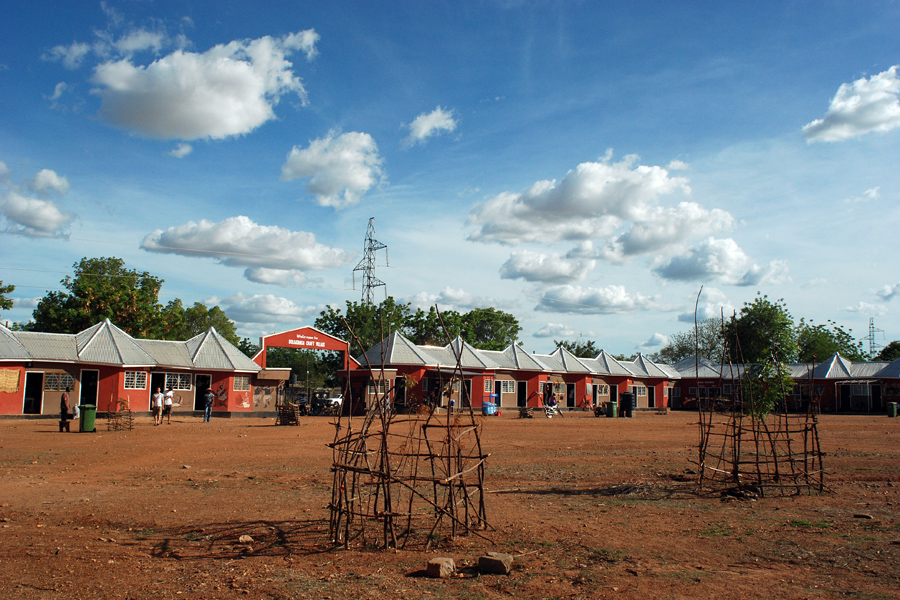
The first image is of the Bolga "craft village". While it does "somehow" resemble a village, they do not actually demonstrate any art or craft-making here, unfortunately. I feel it's a lost opportunity for Bolga craftspeople, given the huge amount of space available there. If you do want to see weaving of cloth in action, head to the Bolga market, about 800 m from here. You can also ask around to visit basket makers in Bolga if you're interested. The photo below is from the Single Mothers Association located here in Bolgatanga in the Upper East Region.
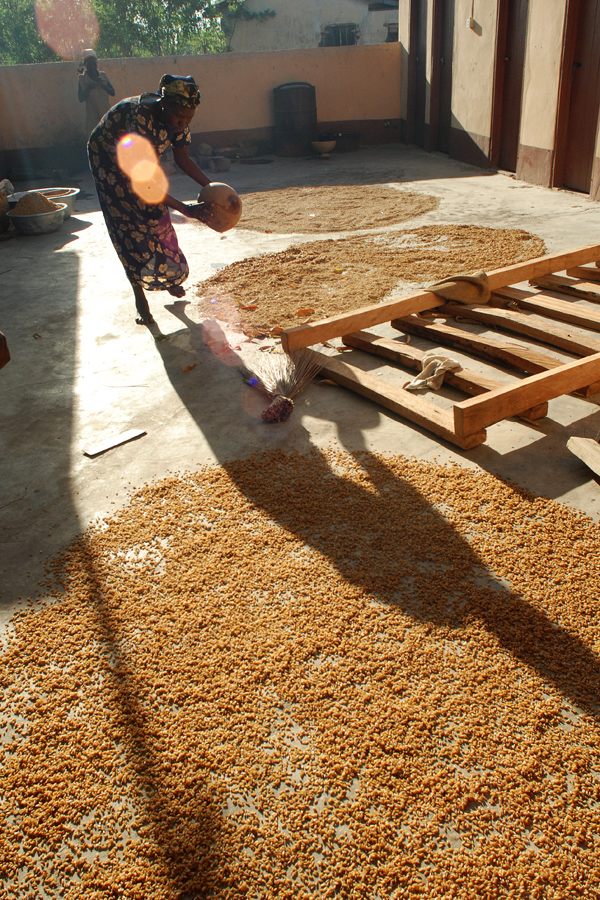
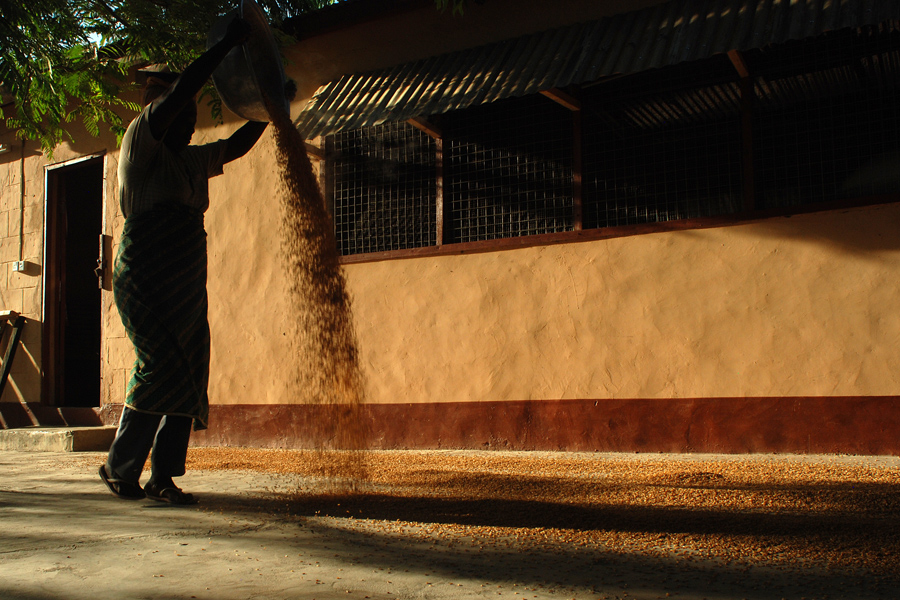
And in the photo below is a demonstration of "winnowing" the rice which basically helps remove rubbish and any unwanted particles from the rice.
You can read more about the Upper East Region of Ghana here. And then, finally, many people do visit Paga crocodile ponds which are on the border with Burkina Faso. Check out this photo. If you ever wanted to get this cosy with a crocodile, then Paga is certainly the place to do it. It's about 45 minutes north of Bolga by taxi or an hour by tro.
Hey, For those interested in inspiring women leaders in Africa, check out Single Mothers Association's website. They're a small NGO based here in Bolgatanga in the Upper East Region of Ghana working with single mothers. Women get short shrift here, even by comparison with other parts of Ghana, and "Madame Stella" and the other members are doing their best to give women an opportunity to earn an independent income for their efforts.
A photo of a sunrise near home...6 a.m. in the morning
The boys playing the beautiful game near home recently. You can see the dryness at this time of year. The rainy season will begin again around April or May.
I took these photos on market day in Bolgatanga. Every third day, in rotation, basket makers come into town from outlying villages and sell their baskets to middle-men traders. Sometimes they may have only 2 or 3 baskets to sell, but this is enough to buy food for a few more days.
In the Insider's Guide to Ghana we outline a workshop you can do with women basket makers in a village just 5 minutes outside of town. Half-day and full-day workshops will include weaving and taking home your own basket, a village tour and experiencing a taste of life in northern Ghana. The workshop will cost 20 GHC for a full day and 15 GHC for half day, inclusive of finished basket--your gift. Look out for this and hundreds of other insider tips and off-the-beaten track attractions in the guide--coming soon!
We have a new site www.g-lish.org where you can read all articles from This is Ghana in a much more organised fashion. Read Nature's Masterpieces: Clouds in Ghana there.
I took these two photos recently. Breath-taking: Nature (not my photography). People go on about the sun in Africa but the clouds are what capture my imagination here.
We have a new site www.g-lish.org where you can read all articles from This is Ghana in a much more organised fashion. Read Favourite 'Secret' Food Spots in Ghana there.
My top recommendations for 'off the beaten track' chop bars and restaurants in Ghana. They’re mostly unlisted and they’re worth a visit if you’re in town. Please add your own recommendations or comments good or bad about anything listed.
The one and only Eli above.
Elimax Spot on the way to Elmina.
Eli’s is unsurpassed for taste, value, laughs and hugs anywhere in Ghana. She cooks a dish of the day, much like an Italian trattoria. If you call ahead, she’ll cook especially to order. Eli doesn’t use palm oil and she’ll make veggie-versions if you ask.
Main dishes:
Red Red: Spicy beans and fried plantains. The best I’ve tasted.
Palava sauce with boiled yam and plantain: Absolutely brilliant.
Fufu with ground nut soup: Tasty, especially the veggie version.
Akple and Okro stew: Eli’s akple is better than anywhere else.
Yam Balls and Egg Stew: An obruni favourite. Best yam balls and egg stew anywhere.
Veggie soup with toasted cheese and tomato sandwiches: If you’re craving western food, this is a winner.
Fish or chicken and chips: Yep, fish and chips and it satisfies the cravings.
Gari fotor: An Ewe specialty a bit like spicy couscous with stew. Seriously great. It’s not even worth trying it anywhere else.
Eli has a group of Ghanaian regulars who usually go for the Akple or the fish and chips. I recently returned to Elmina for a visit and dinner turned out to be gari fotor, my favourite. When I walked around the back Eli smiled and said, ‘It was for you’. She’ll make it for you too.
Each meal is served with meat (chicken or fish) and a huge mixed salad. She washes the veggies in pure water. If you’re vegetarian, Eli will give you a boiled egg instead of meat. Tell her before hand. One meal is 4.50 Cedis per person, including the main dish, meat and salad. Amazing value. She also serves the usual range of drinks, but doesn’t always have them all. Just ask.
A group of volunteers enjoying Gari Fotor
If you want something different or special, she can prepare that too. The important thing is she needs notice as she goes to the market daily to buy fresh ingredients.
Contacts and directions:
Don’t be put off by coming from Cape—it’s only about 20 minutes and quite easy. From Cape Coast catch a taxi to Elmina (a share taxi is about 70 pesewas). Ask the driver to stop at ‘Hotel Junction’. They all know it. It’s the junction before Elmina Junction. (If you go past the Shell filling station on your left, you’ve gone too far. It’s just before Shell.) At Hotel Junction there are signs for Elmina Beach Resort on the road to the left. Walk along that road. Eli’s place is just ahead on the right as the road curves around. You can’t miss the apricot/white wall which, incidentally was painted by some great WIP volunteers last summer. The Elimax sign is opposite. CALL HER ON0203939247.
If you’re coming from Elmina, go along the beach road and past Elmina Beach Resort and keep curving to the left. Eli’s is just around the curve on the left. If you’re coming from Elmina or T’di on the highway, ask the driver to stop at Shell or Hotel Junction and walk from there. If in doubt, ask anyone for EliMax and they’ll show you.
Wander in the picket fence gate. Say hi. Give her a hug. She’ll look after you. Call in advance and find out the day’s dish or order your own. I promise to add the number shortly. My phone was stolen so waiting for it to come from a mate.
African Pot Spot—Fufu!
The best fufu and soup I’ve ever had. Even fussy Godwin says it's the best he's tasted. It’s just off the highway heading to Eli’s on the right before Hotel Junction. If you’re coming from Takoradi or Elmina, it’s on the left after Hotel Junction. You’ll see the colourful sign. It’s about 3-4 Cedis for fufu with a huge piece of chicken or meat. Um, to the best of my knowledge, it doesn't sell pot.
Cape Coast
Janet’s Egg Sandwiches
Outside Oceanview Internet Café. The sign doesn’t lie: egg sandwiches are around 60 p. Toasted cheese, tomato and omelet sandwiches are about 1.4 C and will keep you going all day. Tea is about 60 p.
Jollof Rice Lady
If your back is to Melcom in Cape, look over the road. There is a large woman with a stand of pots in front of a cloth shop. Her name is Adwoa. Her jollof is excellent. A big bag of rice, boiled beans, and a boiled egg and stew is 1 C. If avocado is in season, cutting one into your jollof is delicious.
Kumasi
I tried, but I never found any great hidden eats here. If anyone knows, please say! I’m simply endorsing a favourite, Vic Babboo’s, in Adum near the banks. My favourites were pizza, Indian dishes (the owners are Indian), the Lassis, and the salads.
Bolgatanga
International Travelers Inn: egg sandwiches and tea
A non-descript boxy grey covered spot on the main street is a little gem. From the south end of the main street (the opposite end from the SSNIT building), it’s just on your right. They serve excellent egg sandwiches and tea for 1.5 C. The huge range of baskets in the warehouse square behind are worth a look.
Wakye
Exactly opposite International Travelers Inn is the best wakye I’ve ever had. It has a spicy, gingery base and doesn’t send you running to the toilet. A bag with egg costs 1 C.
Rakia’s Inn
TZ with guinea fowl
If you’re after TZ, don’t go anywhere else. On the main street, go to the post office and turn into the dirt driveway beside the post office car park. About twernty metres ahead on the left is Rakia’s in a free standing building with two double-doorways. It’s next to a Mosque. Try their ‘TZ with betel’ (spinach-like) soup in a ground nut base with guinea fowl for about 3.5-4 Cedis.
Speedlink
Up from the STC towards town. Try fufu for about 4 Cedis with chicken or other meat. The other great dish is mixed salad. Strips of chicken are mixed through a huge plate of truly mixed salad and baked beans with boiled eggs sliced on top. 4 Cedis.
Good Taste
At the other end of the main street is the cheapest, good chop in town. It’s the yellow spot on your right, just past the two shops on the corner coming from the SSNIT building on the main road. A plate of fried rice or jollof and salad (cabbage) and a small piece of chicken is 1.5 Cedis.
SWAT Cafe
This is the Vic Babboo’s of Bolga, run by an affable Ghanaian man who knows how to cook. Their pizza, their signature dish, is not cheap at 7-10 Cedis. Although not the best on earth, it does the trick. At least it tastes fresh and hand made. The Ghanaian and Indian dishes are great. His okro stew rivaled Eli’s for taste.
Accra
Several volunteers raved about the ‘Jerk’ (and all I could think of was Steve Martin) and made special trips for it. Then I tried it. It’s similar to Portuguese chicke: grilled on a BBQ—and addictive. A generous plateful with spicy sauce is 5 Cedis which is miraculous in Accra. Or, you can get take-out in a box. Unfortunately, I didn’t take down directions. It’s about three streets behind Frankie’s in Osu. Turn left out the door of Frankie’s down the side street (next to the Chinese restaurant) and then right at the first street on the right and then left and start asking around. It’s in a little free-standing building on its own in a quiet street not far back.
Ko-Sa Beach Resort in Ampenyi, about twenty minutes past Elmina, along the same road that takes you to Brenu, serves brilliant food. It’s run by a German couple and they’ve put a lot of effort into a good, inexpensive and delicious menu and good customer service. I’m writing a separate review on them shortly.
Green Turtle, past Takoradi from the same junction (Agona) that takes you to Busua or Butre, is the other great hide out for good food and an even better cocktail list and atmosphere.
We have a new site www.g-lish.org where you can read all articles from This is Ghana in a much more organised fashion. Read Misty morning in Bolga there.
I couldn't believe my eyes when I woke to find the neighbourhood shrouded in mist. I can't remember the last time I saw mist! Although mist usually comes with cold, this didn't. But it did create a lovely, calming atmosphere.
These kids were so excited to see their image on the digital camera afterwards.
The plant above growing on the ground is "ground nuts" (peanuts), a major crop up here.
We have a new site www.g-lish.org where you can read all articles from This is Ghana in a much more organised fashion. Read30 minutes in the life: Bolgatanga there.
This is 30 minutes in the life of a walk around home in Bolga yesterday. I included this last pic because, even up here, satellite dishes are not unusual...