What are the best clothes for traveling long, hot distances in Ghana as a woman?
The easiest clothing to wear in a hot country are light and loose cotton skirts, knee-length, loose shorts or light, long trousers like cargo pants or drawstring pants.
T-shirts, tank tops, and other stretch-knit tops are perfect. They're light and easy to roll up into small balls to travel light. They also wash well and dry quickly.
I discovered these fantastic designs by tsevis at Flickr when I was doing a search in google images for another post. This is the one and only Essien. I love how he had incorporated Kente patterns into his mosaic. This really looks like Ghana feels: vibrant, jagged and heading every which way. I'm not quite sure about Essien's face here, but the design is fantastic.
These are all from the series South Africa 2010. This is Mr D. Drogba-who else? Tsevis describes this: "Experimental mosaic portrait of Didier Drogba for the World Cup 2010 in South Africa. Studying the great African patterns tradition and experimenting with a limited color palette. This illustration is made with just 11 colors."
This is a Liberian woman. "Experimental mosaic portrait of a smiling Liberian girl. Working with stars and stripes again as well as with more traditional African colors."
I think this is my favourite. I love the blend of earthy, African colours, the patterns and the pose. "Experimental mosaic portrait of the Cameroonian footballer Alexandre Dimitri Song Billong for the World Cup 2010 in South Africa. Studying the great African patterns tradition."
Tsevis describes this image: "Mosaic portrait of Djibril Cissé, the French footballer of Ivorian descent who is making every Panathinaikos FC fan happy. I am wishing Djibril to be recalled to the French National team and play in South Africa's World Cup 2010."
There is a lot of beautiful and inspiring work in his collections for the web and magazines and all sorts of things on a huge range of subjects like ballet, technology, art, social media, and so on. Check out Tsevis's photostream at Flickr.
We started a new series over at G-lish about how to start and run your own NGO in Ghana. We're in the process of setting up our own and we felt that those who aspire to set up an NGO in Ghana, or in Africa, or anywhere for that matter, may find this useful. If you're looking for NGO work, we'll be talking a little about that too.
We'll be posting over the coming weeks all the steps required in Ghana with contact details to relevant agencies.
We'll also be posting sneak peaks into our "Glish NGO diaries", the trials and tribulations. Lots of that, I can tell you.
Ghana, while in Africa, is still a relatively safe country in which to travel and it’s safe to bring cash. Up to one thousand US dollars is a safe amount. The major currencies, including US dollars, Euros, Yen, Canadian Dollars and Australian Dollars, can be changed at any of the numerous currency exchange bureaus in all main towns and tourist centres. Plastic Cards in Ghana: Bringing a credit card to Ghana is helpful as a back up or as a main source of accessing money for travel, although it would be unwise to rely on this alone should the card be stolen. A mix of cash and credit card is the best solution.
Credit and bank cards can be used to withdraw cash from ATMs, although you will be charged a fee by your credit card company for every withdrawal.
EDIT: On a recent return visit to Ghana in 2017, some traders STILL quote prices in short-hand from the old Cedi currency. In other words, 10,000 for 1 Ghana Cedi.
Read the new Ghana Cedi to understand the difference and what traders mean when they're talking old Cedi language.
If you’ve been interested in funding or donating to development projects around the world, you may understandably be overwhelmed by the number of web sites and options. However, Global Giving take the stress out of this. This is really an excellent site with hundreds of projects all over the world categorised by "Children" or by nation or "environment", and so on. Decide where your interest lies and then find a project to help fund. Check out "Learning Centres for Rural Afghan Women," for example. Photo is courtesy of this project at Global Giving. Read the whole story at Are You MaD?: Development Project.
I wrote an article for Suite 101 on how to get a Ghana tourist or visitor visa. The article is straightforward and includes all the details you'll need.
"The first option is to submit applications in person at the nearest Ghanaian embassy or consulate to the place of departure. Processing times vary between three to five working days, on average. It is advisable to allow another week, in addition, in case of problems.
Apply Ghana Visitor Visa by Post
Alternatively, send the application by registered post to the nearest embassy or consulate. Ghana embassy web-sites will suggest allowing up to two working weeks for the application to be processed and reposted in return. Allow an extra week to be safe. It is advisable to follow up a postal application by telephone to ensure it has been received and is being processed."
Read the entire article for best results and links to embassies and Ghana immigration at Suite 101, Get a Ghana Tourist Visa.
You might also want to read about the new Ghana Cedi and how to work out the difference between the old Cedi still quoted everywhere and the new Ghana Cedi.
This idea hit me about the same time the storm hit last night and while I was feeling a little malaria-ish. Ish. Not too bad. Better now. Not sure what it was, just the usual symptoms, but mild. Anyway. This is jus an idea.
Free accommodation you say? Free hotels?
Well, I'm throwing this idea out to you, feisty folks.
Visitors to Ghana: What do you think about a kind of host/exchange stay network in which you would get to stay for a nominal, small fee in the homes of Ghanaians while traveling around Ghana? The basic idea is to stay with a family or individuals (hmmm, potential issues) and show them how to do something. Stay/exchange, basically.
Ghanaians: What do you think about the idea of hosting visitors for a nominal fee to cover the basics, but they are obliged to teach you something that you want to know about in exchange for the very low cost?
Hosts might want to know how to start a blog, how to type, how to format a PC, how to write an email, how to fix a car or build a new summer hut. These are skills that visiting travelers may have and be willing to offer families in exchange for staying with them.You'd tick boxes to say what skills you'd want and someone looking for rooms could work out their plans by checking out where they could help out.
I'd do it.
I think it would be a win/win but there could be some issues. Do you think this would work?
Sort of in the couchsurfing vein, but giving back. Couchsurfing, incidentally, is where you get to stay for free on others' couches while traveling the world.
By the way, I just looked up Ghana on couchsurfing--668 couches apparently. OK, so the idea is possible. Check out all the couches in Ghana. You can stay for free in Ghana.
The room/volunteer a hand exchange thing in Ghana could work something like that.
Well, that was my crazy malarial/storm idea, let's just hope it doesn't start raining geckoes or we're all buggared.
This photo of Larabanga Mosque in Tamale in the Northern Region is courtesy of Wikimedia Commons by Erik Kristensen.
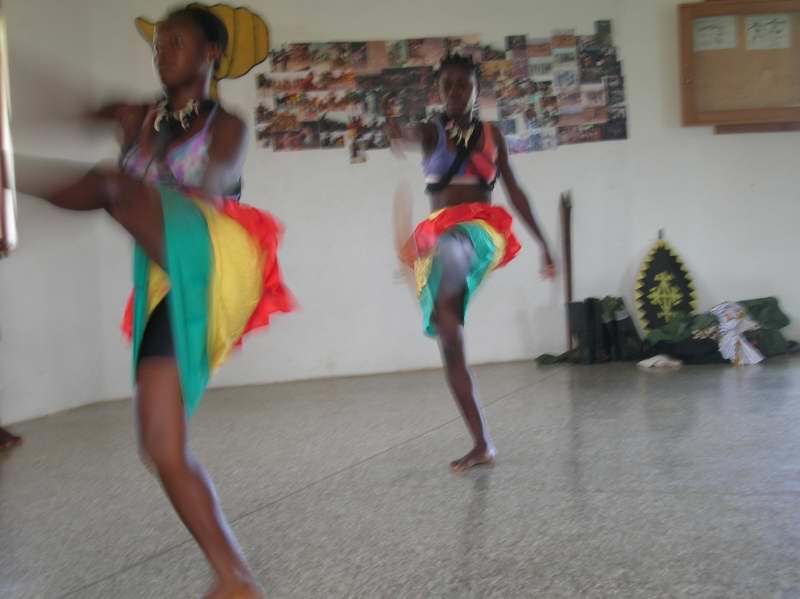
These are a series of photos taken in 2005 showing dance rehearsals in Ghana. In these photos members of Asanti Dance Group were rehearsing in their summer hut at Assase Pa in Cape Coast, Ghana, on a warm afternoon. The drumming was so loud that it attracted local school children on their way home from school. You can see their faces crowding the doorways. They were also crowding all the windows, surrounding the hut and clapping and dancing along with the performers.
You can read more about Ghana dance and Asanti Dance Group at their website. If you're interested in learning dance in Ghana, or say taking a dance vacation mixed with volunteering in Ghana (which is a lot like I did back in the beginning), then check out their site. Many of the performers are now living in Melbourne, Australia, so if you're in that neck of the woods you might contact them and catch performances there. The others live in Cape Coast and occasionally travel around Ghana teaching, performing and demonstrating Ghana dance styles and techniques.
Asanti, incidentally, is their spelling and is Swahili for "thanks".
You can check out all the Ghana Highlights by clicking these links and planning your itineraries in depth around the places you most wish to visit. You will find a lot of information about Ghana here. You can also check out our Ghana travel guide and see a sample before buying by going to http://www.g-lish.org/ghanaguide.
If you are planning to come to Ghana to take a vacation, tour the country, or even create your own package tour, then these two tours may be for you.
Itinerary 3: 19 Days Taking it easy version.
Days 1-6: Beaches, man. Accra-Cape-and further west. And a bit of history and culture.
Days 1-2: Accra-Cape. As per the first itinerary, mix and match activities here. Hang out at Oasis.
The view over Benya Lagoon from the west side of the Elmina Castle ramparts.
Days 3-6: Any or all of touring, say, Green Turtle Lodge, Ko-sa Beach Resort or Axim Beach Resort. If Axim, then add on a visit to Nzulezo stilt village, for the day, using the resort as a base.
Days 7-14: Northern adventure. Elephants, Dude. And crafts and culture.
Day 7: Takoradi to Kumasi by STC or tro. STC departs T’di daily at 4 a.m. or 12 p.m. to Kumasi. It goes via Cape Coast. Tros leave regularly throughout the day.
If you arrive in Kumasi early, you could visit the National Cultural Centre in town.
Day 8: Travel to either Tamale/Bolga. STC bus departs Kumasi to Tamale Mon-Sat at 10 a.m. There’s no Sunday service. All things being equal, you should arrive in Tamale around 4 p.m. You could, if you’re lucky, still nab a ticket for the bus to Mole National Park on this day, if that service is late, which it often is, and not over booked. Even if over-booked, there are ways to get tickets. If you can’t get tickets, you could travel on to Bolga, another 2.5 hours by tro, on the next car leaving, and stay overnight there.
Basket makers in traditional home in Bolgatanga
Day 9: Bolgatanga: Visit basket makers at basket making workshop in village on outskirts of town. Or visit Sirigu potters for the day and Navrongo Cathedral. Overnight in Bolga.
Day 10: Stay in Bolga longer or wake early and travel to Tamale for that day’s bus to Mole National Park. Catch tro or Metro Mass Bus. MM (orange buses) leave around 7 a.m. from the station which is on the Zuarongo Road behind Sand Gardens Hotel. Tros leave regularly from the main station in town. In Tamale, buy ticket for Mole National Park bus at main tro station where you’ll alight. Wait. Could visit market about 5 minutes on the right outside the station. Arrive in Mole National Park late that night.
Day 11-12: Tour around Mole National Park and hang out. Visit Larabanga should you wish.
Day 13: Leave Mole National Park on 4 a.m. bus to Tamale. From Tamale head either to Accra or Kumasi. STC leaves for Accra at 6 a.m. and 4 p.m. every day. It leaves for Kumasi at 7 a.m. Your main hope is that it’s late and that you can still get a ticket when you arrive some time after 8 a.m. Otherwise, there are other options such as Metro Mass to Kumasi or a tro. I feel it’s better to stay in Kumasi—much cheaper—and travel to the Volta from there as you save half a day. You can go directly from Kumasi on a vehicle to Koforidua, and then in another vehicle from there to either Kpong, Ho or Hohoe easily. That is quicker than going to Accra and then to the Volta area. Let’s say you do that on Day 14.
Days 14—19 Waterfalls, Dude. And Culture, if you’re into that kind of thing.
Day 14: Kumasi to Hohoe. Hang out and relax. You’re the Dude afterall.
Day 15: Hang out and walk to the lower or upper falls.
Day 16: Same, or head to any of the points suggested in the first itinerary.
Day 17: Same.
Day 18: Same.
Day 19: Accra, unfortunately, and home…or next stop.
By the way, this is the Dude. Connection with Ghana? Tenuous, but I reckon the Dude wouldn't mind hangin' out on some of the beaches.
Itinerary 2: The 19 day Ghana tour for troopers: tough Ghana tours
Days 1-5: Beaches, History, Culture, Workshops.
Days 1: Accra. Arrive. Sight-see, depending on arrival time.
Day 2: Straight to Takoradi by STC and on to Axim. Stay at Axim Beach Resort for night. STC departs from Kaneshie in Accra at 2.30 and 4.30 p.m. Mon-Sat. It is better to go to Kaneshie Fast Cars and get the next one going to T’di. You’ll be there in 4 hours, say, mid-day. Then the tro from T’di to Axim will leave soon and you’ll be there late afternoon, before dark for sure.
The stilt village--a day trip from Axim Beach Resort.
Day 3: Visit Nzulezo Stilt Village. Still stay overnight in Axim.
A common sight along the coast of Ghana: fishermen working, singing and hauling in the nets.
Day 4: Head back to Cape Coast via T’di. Could visit Cape Coast Castle in afternoon.
Day 5: Visit Elmina Castle or go to Kakum National Park, or both.
Day 6-8: Ashanti and Brong Ahafo Region. Nature, Craft, Culture, Causes
Day 6: Tro to Kumasi. If you leave by 8 a.m. you’ll arrive by mid-day. Travel on to Lake Bosumtwi for night. Stay overnight.
African Rainbow at Lake Bosumtwi
Day 7: Hang out at lake in morning and stay another night or return to Kumasi and go to Bonwire Kente village for the afternoon. Stay overnight in Kumasi.
Day 8: Travel by tro to Techiman, 3 hours north-west. Head to Operation Hand in Hand for the night from here. Stay overnight.
Days 9-12/13: Crafts, Nature, Wildlife
Day 9: Wake early, return to Techiman and catch tro to Tamale, about 4.5 hours. Buy ticket for Mole National Park if in time. Head to Mole that afternoon. Overnight Larabanga at Salia Brothers or Mole Motel.
Day 10: Mole NP tours.
Day 11: Depart Mole at 4 a.m. Arrive in Tamale by around 8 a.m. Catch tro on to Bolga. Arrive in Bolga by around mid-day/one. Do a basket making workshop, visit Sirigu or Navrongo.
A traditional house in the Upper East region during the rainy season (June-Sept).
Day 12: Stay in Bolga another day or travel south. Metro Mass Buses depart daily at 8 a.m. to Accra for 15 GCs from the station on the Zuarango Road behind Sand Gardens Hotel. Buy the ticket the day before and be there by 7 a.m. You’ll arrive in Kumasi at about 6 p.m. I advise you to overnight here and change for a different car to head to the bead making area from there.
Day 13-19 Adventure, Waterfalls, Crafts, Rivers
Day 13: Wake and visit the cultural centre if you like. Or, catch a tro to Koforidua from Kejetia station. This will take about 5 hours. From here you could visit the bead making areas as you make your way towards Akosombo and the Volta Region.
Or, you could catch a tro to Nkawkaw, about 1.5 hours, and then travel across to Kpando by crossing Lake Volta twice, as I described in “the road less traveled” (but in reverse), and get there that night, without overnighting in Donkorkrom.
Kumasi-Nkawkaw: 1.5 hours, Nkawkaw-Adowse port: 2 hours, Adowse by canoe to Ekye on other side: 40 mintues. Ekye to Donkorkrom: 90 minutes. DKK-Agordeke: 1 hour. Agordeke-Kpando: 2 hours. Kpando—Hohoe 30 minutes. This looks hard but it’s pretty easy. If you left Kumasi by 7 a.m. or earlier (not later), you can arrive in Kpando by evening.
Day 14: If you’re in Akosombo, you can read any of the itineraries above and Part 2 Highlights to put together the next 5 days.
If you’re in Hohoe, travel to Wli and climb waterfalls and then relax.
Day 15: Relax! You’ll need it.
Day 16: Head to Ho and see weaving at Kpotoe or stay at Mountain Paradise and visit more waterfalls.
Day 17-18: Stay at Akosombo for 2 nights and visit bead makers as short day trips if you wish.
Day 19: Accra. Tired and ready to sleep on the plane for 10 hours!
We hope that this helps you plan a Ghana vacation or holiday. Don't forget to check out the guide at http://www.g-lish.org/ghanaguide.
You can read the next in our serious Are You Mad: Young People at G-lish. This post focuses on the differences we can make in the lives of children and youth around the world.We hope it inspires you to shake things up in your part of the world. Here is an excerpt:
'Unfortunately, in much of the developing world young people don’t have a voice. Many factors underlie this including socio-cultural norms such as “children must be seen and not heard” (Ghana), or there is no youth policy to address specific youth needs (Ghana, too).
If you’ve traveled in developing countries you’ll know that many children begin working from the moment they can walk. Here, where we live, I’m no longer shocked to see four, five or six year old girls carrying their baby siblings on their back, wrapped in cloth, while simultaneously carrying oranges on their head to sell for 5 cents in the market so they can make a few cents for the day. This is completely, abhorrently, normal. This also touches on education—denying these children an education because they’re outside making money trading on the streets.'